
By Dr. Muhammad Awais Rabbani, MBBS · Updated 24 October 2026 · Editorial policy
For adults aged 20 and over, a BMI of 18.5 to 24.9 is the healthy range. Below 18.5 is underweight, 25 to 29.9 is overweight, and 30 or higher is obesity (CDC).
Your BMI
Your weight relative to your height.
- Category
- Based on CDC and World Health Organization adult cut-offs.
- Category using Asian action points
- Risk starts rising at a lower BMI in people of Asian ancestry (WHO action points 23 and 27.5).
- Healthy weight range for your height
- Weights giving a BMI of 18.5 to 24.9.
- Waist-to-height ratio
- For clinicians and coders
- ICD-10-CM, FY2027 code set. A secondary code only; see the coding section below.
This calculator uses adult cut-offs. For ages 2 to 19, BMI is read as a percentile for age and sex. Use the CDC child and teen BMI calculator.
This tool gives general information and cannot diagnose a condition. See our editorial policy.
What is BMI (body mass index)?
Body mass index is your weight in kilograms divided by your height in meters squared. It turns height and weight into one number that clinicians use to screen adults for underweight, overweight and obesity. It is a screening figure. It does not measure body fat directly and cannot diagnose a disease on its own (CDC).
It needs only a scale and a tape, which is why it sits on almost every adult intake form.
Adult BMI ranges and what each category means
The CDC sorts BMI for adults into six bands. Under 18.5 is underweight, 18.5 to 24.9 is a healthy BMI, 25 to 29.9 is overweight, and 30 or higher is obesity, split into class 1 (30–34.9), class 2 (35–39.9) and class 3 (40 and above). These weight categories apply to everyone from age 20 upward (CDC).
| BMI category | BMI range | Asian-population action point |
|---|---|---|
| Underweight | under 18.5 | under 18.5 |
| Healthy weight | 18.5–24.9 | 18.5–22.9 |
| Overweight | 25–29.9 | 23 or higher: increased risk |
| Obesity class 1 | 30–34.9 | 27.5 or higher: high risk |
| Obesity class 2 | 35–39.9 | — |
| Obesity class 3 | 40 or higher | — |

People of Asian descent develop type 2 diabetes and heart disease at a lower BMI, so a WHO consultation set Asian-population cut-offs at 23 and 27.5 (WHO Expert Consultation, Lancet 2004). The American Diabetes Association screening threshold follows suit, testing Asian American adults for diabetes from a BMI of 23 when at least one other risk factor is present (ADA Standards of Care in Diabetes—2026, Section 2).
What is a healthy weight for your height?
A healthy weight range for your height is any weight that gives a BMI of 18.5 to 24.9. At 5 ft 9 in, that is about 126 to 168 lb. At 175 cm, it is about 57 to 76 kg. The calculator prints your own range in your units.

To work it out yourself, square your height in meters, then multiply by 18.5 and by 24.9. At 175 cm, 1.75 × 1.75 = 3.0625, so the range runs from 56.7 kg to 76.3 kg. Your ideal weight inside that band depends on muscle, frame and health history, which is why a range is more useful than a single target.
Is a BMI of 26, 31 or 35 a problem?
A BMI of 26 is overweight, 31 is obesity class 1, and 35 is obesity class 2. Disease risk rises with each step, and some steps also change the treatment a doctor can offer you. From 27, medication becomes possible when a weight-related condition is present, and from 35, surgery is a recommended option.
- 25 to 26.9: overweight. A clinician usually checks waist, blood pressure and glucose.
- 27 to 29.9: still overweight, but FDA labels for Wegovy and Zepbound allow anti-obesity medication from 27 with at least one weight-related comorbidity (Wegovy label; Zepbound label).
- 30 to 34.9: obesity class 1. Medication is an option without a comorbidity; surgery may be considered with metabolic disease (ASMBS/IFSO 2022).
- 35 to 39.9: obesity class 2. Surgery is recommended with or without other conditions (same source).
- 40 and above: obesity class 3. Surgery is recommended (same source).
How BMI is calculated
The BMI formula divides weight in kilograms by height in meters squared. In US units, multiply your weight in pounds by 703, then divide by your height in inches squared. Both routes give the same number, usually rounded to one decimal place (CDC).
Metric: BMI = kg ÷ m² 70 kg at 1.75 m → 70 ÷ 3.0625 = 22.9 US: BMI = lb × 703 ÷ in² 160 lb at 69 in → 160 × 703 ÷ 4,761 = 23.6Do BMI ranges change with age or sex?
For adults, no. The same BMI ranges apply to every adult aged 20 and over, so two adults of any sex with the same height and weight land in the same category, whether they are 25, 45 or 60 years old. Age and sex only change the reading below 20, where BMI becomes a percentile (CDC).
- Adults 20 and over: one set of cut-offs, and no separate BMI for men. Body composition differs by sex, so waist adds more than a sex-specific table.
- Under 20: children and teens are compared with others of the same age and sex.
- 65 and over: muscle loss can hide extra fat behind a normal-looking number.
What BMI misses — and the second number to check
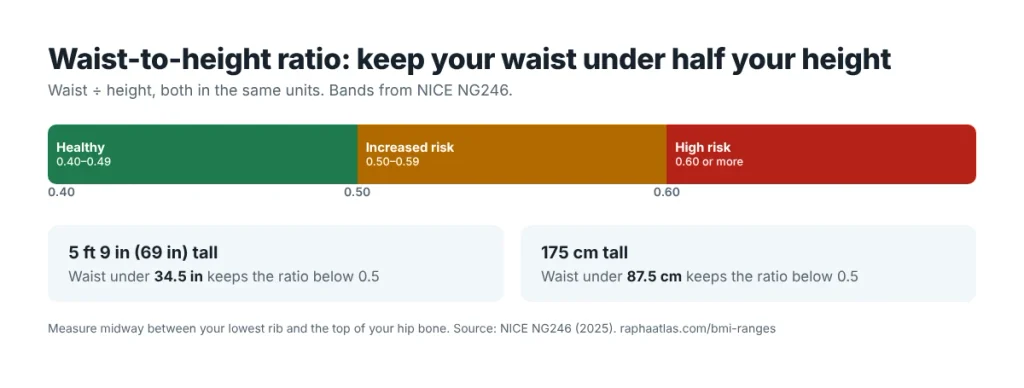
BMI cannot tell muscle mass from body fat, and it says nothing about where fat sits. Two adults with a BMI of 27 can carry very different amounts of abdominal fat and very different disease risk. NICE now advises pairing BMI with waist-to-height ratio, where 0.5 or more signals raised risk (NICE NG246).
The limitations of BMI cut both ways. A muscular athlete can read overweight with a low body fat percentage, and an older adult with little muscle can read healthy with excess body fat. NICE grades waist-to-height ratio as healthy at 0.4 to 0.49, increased at 0.5 to 0.59 and high at 0.6 or more (NICE NG246).
Keep your waist under half your height. At 5 ft 9 in, under 34.5 inches. At 175 cm, under 87.5 cm.
The 2025 Lancet Commission concluded that BMI alone should not diagnose obesity. Excess fat should be confirmed with a second measure such as waist circumference, and clinical obesity means excess fat already impairing organ or body function (Rubino et al., Lancet Diabetes & Endocrinology, 2025).
Which health risks rise as BMI goes up?
A high BMI is linked to a higher risk of prediabetes, type 2 diabetes, hypertension, heart disease and obstructive sleep apnea. The increased risk grows steadily as BMI climbs, and grows faster when extra weight sits around the waist (NHLBI).
- Prediabetes and type 2 diabetes: the ADA advises testing adults with overweight or obesity and at least one other risk factor (ADA 2026, Section 2).
- Hypertension: excess weight raises blood pressure (NHLBI).
- Heart disease, including coronary heart disease (NHLBI).
- Obstructive sleep apnea: in a cohort study, weight gain predicted worsening sleep-disordered breathing (Peppard et al., JAMA, 2000).
If your number sits above 25, start with how many calories you need a day.
How doctors, coders and insurers use your BMI
In US healthcare, your BMI becomes an ICD-10-CM Z68 code on the claim and is one of the checks for anti-obesity medication and metabolic and bariatric surgery. A BMI of 27 with a weight-related comorbidity, or 30 without one, meets FDA label thresholds (Wegovy label). A BMI of 35 meets the surgical recommendation without any comorbidity (ASMBS/IFSO 2022).
| BMI (adult) | Z68 code (FY2027, from 1 Oct 2026) | Anti-obesity medication (FDA label) | Metabolic surgery (ASMBS/IFSO 2022) |
|---|---|---|---|
| 18.4 or less | Z68.18 | No | No |
| 18.5–19.9 | Z68.19 | No | No |
| 20.0–26.9 | Z68.20–Z68.26 | No | No |
| 27.0–29.9 | Z68.27–Z68.29 | With ≥1 weight-related comorbidity | Offer from 27.5 in Asian patients |
| 30.0–34.9 | Z68.30–Z68.34 | Yes | Consider with metabolic disease |
| 35.0–39.9 | Z68.35–Z68.39 | Yes | Recommended |
| 40.0 and above | Z68.41 (40–44.9) to Z68.45 (70+) | Yes | Recommended |
On 1 October 2026, Z68.1 stopped being a billable code. Claims now need Z68.18 (BMI 18.4 or less) or Z68.19 (18.5–19.9), so old templates that still print Z68.1 fail claim edits (CMS FY2027 ICD-10-CM).
A Z68 code is never the primary diagnosis. Clinical documentation rules let the BMI come from a dietitian’s or nurse’s note (ICD-10-CM Official Guidelines, Section I.B.14), but the treating provider must document the linked condition, such as obesity, and the BMI code is reported only alongside it (Section I.C.21.c.3). For prior authorization of a GLP-1 drug or surgery, payers compare BMI, Z68 code and comorbidity; mismatches stall approval.
Drug doses that scale with body size often use body surface area instead of BMI. Codes above follow the CMS FY2027 code set.
BMI questions, answered briefly
What is a normal body mass index?
18.5 to 24.9 for adults aged 20 and over. The CDC calls this the healthy range, and the World Health Organization uses the same cut-offs, with lower action points for Asian populations.
What is a low body mass index?
Under 18.5. It can reflect illness, undernutrition or a slim build, so a healthcare professional checks recent weight loss, diet and blood tests first.
What is the average body mass index in the US?
The CDC reports the share of adults with obesity rather than an average BMI. Between August 2021 and August 2023, 40.3% of US adults had obesity (NCHS Data Brief 508). That is roughly two in every five adults. A reading of 30 or more is common in the US, and being common does not make it lower risk.
What is BMI percentile?
For children and teens aged 2 to 19, BMI is compared with others of the same age and sex. The category comes from that percentile.
Is BMI the same for every adult?
The formula is. The meaning shifts for people of Asian ancestry, where WHO action points start at 23 and 27.5. Tick the Asian ancestry box in the calculator to see both readings.