
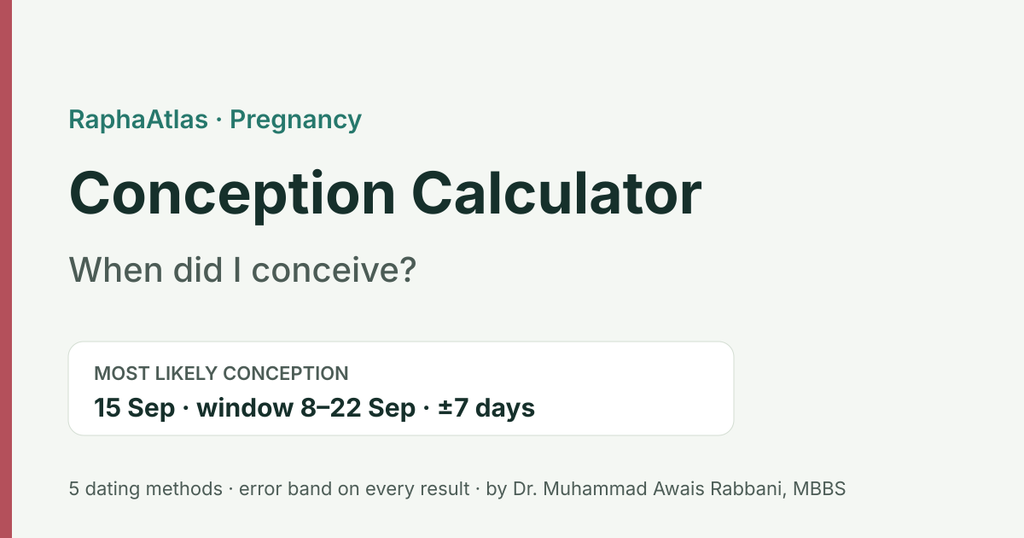
Conception usually happens within a day of ovulation, which falls about two weeks after the first day of your last period in a 28-day cycle, or about 266 days (38 weeks) before your due date (ACOG Committee Opinion 700).
By Dr. Muhammad Awais Rabbani, MBBS · Medically reviewed by Dr. Ahmed Humayon, MBBS · Last reviewed: 19 October 2026 · Editorial policy
When did I conceive?
You most likely conceived within a day of ovulating. In a 28-day cycle that puts conception around day 14, counting from the first day of your last menstrual period (ACOG CO 700). The calculator turns whichever date you know, from a period date to an IVF transfer, into a fertilisation window with a stated margin of error.
- Pick the method that matches the date you have.
- Enter the date. For the LMP method, add your usual cycle length.
- Read the result card, which shows the most likely day, the window around it, and the error band for your method.
Use the most reliable date you have. A first-trimester scan beats a remembered period.
What a conception date is — and why it isn’t the day you had sex
Your conception date is the day an egg was fertilised, usually in the fallopian tube within about a day of ovulation. It can fall several days after the day you had sex, because sperm can wait in the reproductive tract for an egg that has not yet been released from the ovary (Wilcox et al., NEJM 1995).
So is the conception date the same as the ovulation date? Nearly.
The egg can be fertilised for only about 12–24 hours after release (De Jonge, Egg Transport and Fertilization, GLOWM), which means fertilisation lands on ovulation day or the day after. That short span, rarely more than a day, is the fertilisation window this calculator reports.
Sex and conception are separate events. In a study of 221 women trying to get pregnant, conception followed only intercourse during a six-day stretch that ended on the day of ovulation (Wilcox et al., NEJM 1995). Sperm have been documented staying motile in the reproductive tract for up to five days (De Jonge, GLOWM), so sex on a Monday can lead to conception on the Saturday.
How the calculator works: five methods and how accurate each one is
Each method estimates ovulation or fertilisation from one date, then attaches an error band that reflects how reliable that date is. An IVF transfer date and a first-trimester scan give the tightest result. A remembered period date gives the loosest, because ovulation moves around even in regular menstrual cycles.
| Method | What you enter | How conception is estimated | Error band | Source |
|---|---|---|---|---|
| LMP (Naegele’s rule) | First day of your last period + cycle length | Ovulation = cycle length − 14 days after the LMP (a fixed luteal phase). Naegele’s rule adds 280 days to the LMP for the due date. | ±5–7 days at best; wider with irregular cycles | ACOG CO 700; Wilcox et al., BMJ 2000 |
| Due date | Your estimated due date | Due date − 266 days | Inherits the band of whatever set the due date | ACOG CO 700 |
| Ovulation | A tracked or confirmed ovulation day | Ovulation day to the following day | About 1 day, if the ovulation date is right | De Jonge, GLOWM |
| Ultrasound (CRL) | Scan date + gestational age from the crown-rump length | Scan date − (gestational age − 14 days) | ±5–7 days for scans up to 13 weeks 6 days | ACOG CO 700 |
| IVF | Embryo transfer date + embryo age (day 3 or day 5) | Transfer date − embryo age | None for fertilisation; the lab recorded it | ACOG CO 700 |
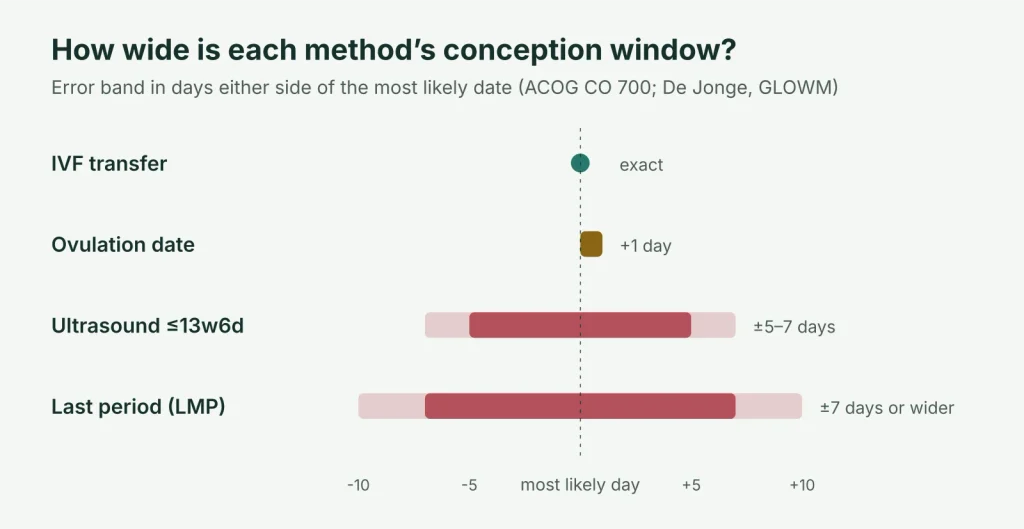
Where does the LMP band come from? ACOG advises changing the due date when a crown-rump length scan at or before 8 weeks 6 days disagrees with LMP dating by more than 5 days, or by more than 7 days between 9 weeks 0 days and 13 weeks 6 days (ACOG CO 700).
Smaller differences are treated as normal error in a date-based estimate from a period, which is why this calculator never shows an LMP result tighter than ±7 days. The real spread can be larger: in a prospective study of 696 cycles, only about 30% of women had a fertile window that sat entirely within cycle days 10 to 17 (Wilcox et al., BMJ 2000).
For IVF, ACOG sets the due date at 261 days after a day-5 transfer and 263 days after a day-3 transfer (ACOG CO 700).
Working backwards from your due date
To find conception from a due date, subtract 266 days (38 weeks). A due date sits 280 days after the first day of the last period, and ovulation is assumed on day 14 of that count, which leaves 266 days from conception to giving birth (ACOG CO 700). This is what a reverse due date calculator does.
Take a due date of 15 March 2027. Subtracting 266 days gives an estimated conception date of 22 June 2026. If an early scan set that due date, allow ±5–7 days, so conception most likely happened between 15 and 29 June. If the due date came only from a period date, treat the window as at least that wide.
If ultrasound revised your due date, use the revised one. EDD (estimated date of delivery) and EDC (estimated date of confinement) on your notes both mean your due date.
If I’m 4, 5 or 6 weeks pregnant, when did I conceive?
If you are 4 weeks pregnant, you most likely conceived about 2 weeks ago. Weeks pregnant are counted from the first day of your last period, which comes roughly two weeks before ovulation in a 28-day cycle, so subtract two weeks from any weeks-pregnant figure to get your conceptional age, the time since fertilisation (ACOG CO 700).
| Weeks pregnant | Conception happened about | Likely range if dated by LMP (about ±1 week) |
|---|---|---|
| 4 | 2 weeks ago | 1–3 weeks ago |
| 5 | 3 weeks ago | 2–4 weeks ago |
| 6 | 4 weeks ago | 3–5 weeks ago |
| 7 | 5 weeks ago | 4–6 weeks ago |
| 8 | 6 weeks ago | 5–7 weeks ago |
| 10 | 8 weeks ago | 7–9 weeks ago |
| 12 | 10 weeks ago | 9–11 weeks ago |
The two-week offset holds for a 28-day cycle. With a 35-day cycle, ovulation comes about a week later, so conception is closer to the recent end of each range.
Why your chart says you’re two weeks “more pregnant” than you conceived
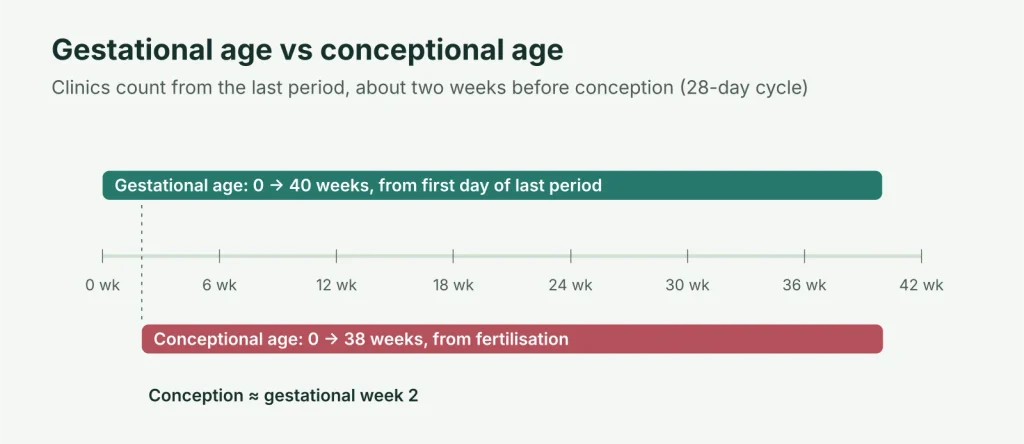
Clinics record gestational age, counted from the first day of the last period, instead of conceptional age, counted from fertilisation. In a 28-day cycle the two differ by about 14 days (ACOG CO 700), so a pregnancy charted at 6 weeks began roughly 4 weeks ago.
Prenatal visits, scan reports and insurance claims all count this way, so “how far along” always means gestational weeks.
On US medical claims, weeks of gestation are reported with ICD-10-CM category Z3A, from Z3A.01 (less than 8 weeks) to Z3A.49 (greater than 42 weeks) (CDC ICD-10-CM). Those codes carry gestational weeks, so the two-week offset appears in billing data too.
Irregular cycles or no LMP: which date to trust
With irregular periods, trust an early ultrasound over your period date. The LMP method assumes ovulation 14 days before your next period, a fixed luteal phase. When cycle length changes month to month, there is no reliable next period to count back from, while a crown-rump length scan up to 13 weeks 6 days carries a ±5–7 day band (ACOG CO 700).
- Use the ultrasound if you have had a scan before 14 weeks.
- Use the ovulation date if you tracked ovulation that cycle with LH tests or a scan.
- Use the LMP only if your cycles are regular and you are sure of the first day of bleeding.
If none applies, your healthcare provider can date the pregnancy with an early pregnancy ultrasound as part of routine prenatal care.
Can you find the exact day you got pregnant?
For a natural conception, no method can pin the date of conception to one day. The best any of them gives is a window of a day or two around ovulation, because the egg stays fertilisable for 12–24 hours (De Jonge, GLOWM) and ovulation itself is estimated. In vitro fertilization (IVF) is the exception, because the lab records the date.
So when you ask what day you conceived, read the window on the result card and treat its middle as the likeliest day.
How many days after sex does conception happen?
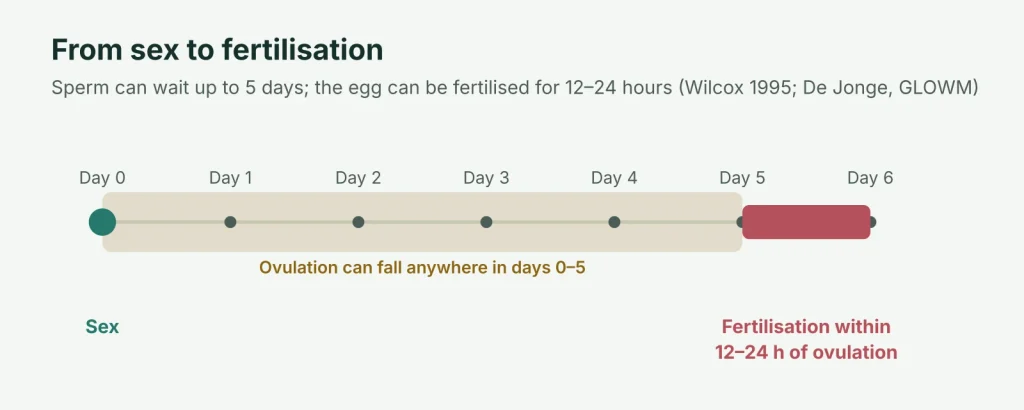
Conception can happen the same day as sex or up to about five days later. Sperm that reach the fallopian tube can wait for ovulation, and in the NEJM fertile-window study, intercourse up to five days before ovulation still led to pregnancy (Wilcox et al., NEJM 1995).
- Day 0: sex. Sperm travel to the fallopian tube.
- Days 0–5: ovulation may happen at any point in this span.
- Within 12–24 hours of ovulation: fertilisation, if it happens at all, limited by oocyte lifespan (De Jonge, GLOWM).
Timing mattered for the odds in that study. The chance of getting pregnant ranged from 10% for sex five days before ovulation to 33% for sex on ovulation day itself (Wilcox et al., NEJM 1995). Because one act of sex can line up with several possible conception days, this is also why timing rarely settles paternity.
What happens next: implantation and a positive test
After fertilisation, the embryo takes several days to reach the uterus and implant. In an NEJM study of 189 pregnancies, 84% of those that became clinical pregnancies implanted 8 to 10 days after ovulation, and pregnancies that implanted later were more likely to end in early loss (Wilcox et al., NEJM 1999).
Home tests detect hCG, a hormone that appears in urine once the embryo has implanted (Wilcox et al., NEJM 1999), so a test taken days after conception will be negative even in early pregnancy.
Conception calendar: other ways to use your dates
A conception calendar maps your likely conception window onto real calendar dates, so you can see which days in which month it covers. The result card above shows yours after you calculate.