
By Dr. Muhammad Awais Rabbani, MBBS · Medically reviewed by Dr. Ahmed Humayon, MBBS · Updated 4 November 2026 · Editorial policy
A whole Hass avocado (136 g of flesh) has about 227 calories, 21 g of fat, 2.7 g of protein and 9 g of fiber, according to the USDA FoodData Central record “Avocados, raw, California” (FDC 171706). Per 100 g it has 167 calories. A large Florida avocado reaches about 365.
227 kcal
136 g of flesh
- Fat
- 21.0 g
- Saturated fat
- 2.9 g
- Carbohydrate
- 11.8 g
- Fiber
- 9.2 g
- Protein
- 2.7 g
- Potassium
- 690 mg
USDA FoodData Central, Avocados, raw, California (FDC 171706)
How many calories are in an avocado?
One Hass avocado has about 227 calories once you remove the skin and seed. USDA FoodData Central lists one California avocado as 136 g of edible flesh, weighed without skin and seed, at 167 calories per 100 g (USDA FDC 171706). Bigger fruit, or a Florida variety, changes the answer.
Weighed it whole? Tick “with skin and seed” in the calculator. It removes the 26% of the fruit that USDA records as refuse, then converts the flesh that is left.
USDA publishes three avocado records, and each one gives a different “whole avocado” number.
| USDA record | FDC ID | Calories per 100 g | Edible flesh per fruit | Calories per fruit |
|---|---|---|---|---|
| Avocados, raw, California (Hass) | 171706 | 167 | 136 g | 227 |
| Avocados, raw, all commercial varieties | 171705 | 160 | 201 g | 322 |
| Avocados, raw, Florida | 171707 | 120 | 304 g | 365 |
Source: USDA National Nutrient Database for Standard Reference, Release 28, basic reports 09037, 09038 and 09039.
That 138-calorie spread explains why one website says 227 and another says 322: each one is reading a different record. This page defaults to the California record because it describes Hass fruit. Even the all-commercial record is weighted 86% California fruit to 14% Florida fruit, according to its own USDA record note (FDC 171705). Switch the calculator to Florida if that is the variety you bought.
Avocado calories by size: small, medium, large and extra-large
A medium avocado has 227 to 250 calories, depending on whose definition of “medium” you use. USDA puts the flesh of one California avocado at 136 g, or 227 calories (FDC 171706). Industry labels imply 150 g of flesh, or 250 calories, because they call 50 g a third of a medium fruit.
That serving definition comes from avocado marketers, citing the Hass Avocado Board (Avocados From Mexico nutrition brochure).
Stores sort Hass fruit by size and mark it with a PLU sticker. The Hass Avocado Board defines code 4046 as a small or medium Hass of about 3 to 5 oz, 4225 as a large Hass of 8 to 10 oz, and 4770 as an extra-large Hass of 10 to 15 oz, weighed whole (Love One Today, Hass Avocado Board). Below, each band is converted to edible flesh by removing USDA’s 26% refuse for skin and seed (FDC 171705), then to calories at 1.67 per gram.
| Size | PLU | Whole fruit with skin and seed | Edible portion | Calories | Fat | Protein | Fiber | ½ fruit |
|---|---|---|---|---|---|---|---|---|
| Small / medium | 4046 | 85–142 g (3–5 oz) | 63–105 g | 105–175 | 10–16 g | 1.2–2.1 g | 4.3–7.1 g | 52–88 |
| Medium (USDA) | none | about 184 g | 136 g | 227 | 21 g | 2.7 g | 9.2 g | 114 |
| Medium (industry label) | none | about 203 g | 150 g | 250 | 23 g | 2.9 g | 10.2 g | 125 |
| Large | 4225 | 227–284 g (8–10 oz) | 168–210 g | 281–351 | 26–32 g | 3.3–4.1 g | 11.4–14.3 g | 140–176 |
| Extra-large | 4770 | 284–425 g (10–15 oz) | 210–315 g | 351–526 | 32–49 g | 4.1–6.2 g | 14.3–21.4 g | 176–263 |
Calories and nutrients per gram from FDC 171706. Whole weights for the two medium rows are back-calculated from the 26% refuse.
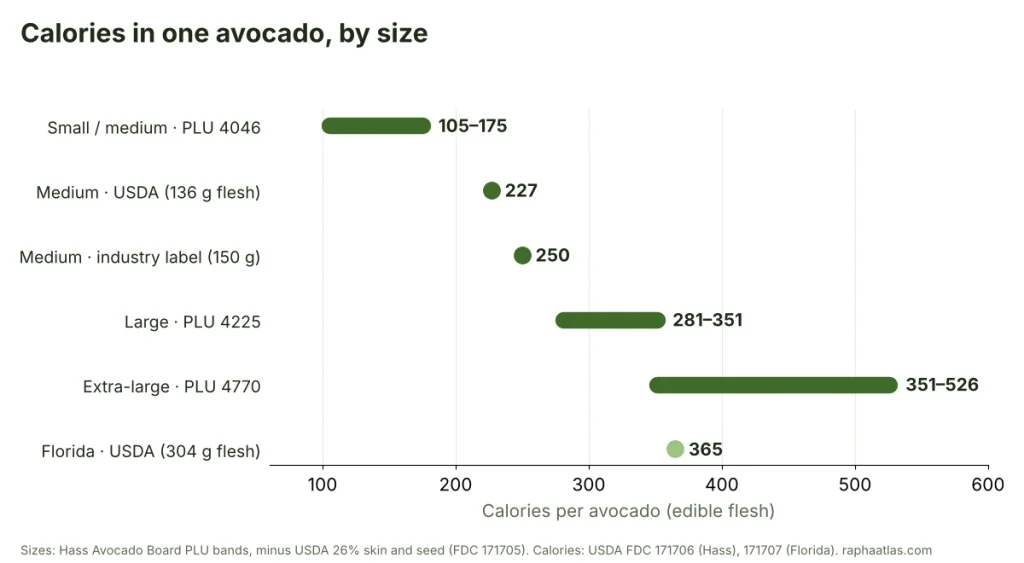
An extra-large Hass can carry more than twice the calories of a small one. That is the main reason the sticker size matters more than the word “avocado” when you log it.
The skin and seed are a large share of what you pay for, about a quarter of the weight. If you weighed your avocado before cutting it, tick the “with skin and seed” box so the calculator subtracts that share. Seed size varies from fruit to fruit, so weighing the flesh alone is always the more accurate option.
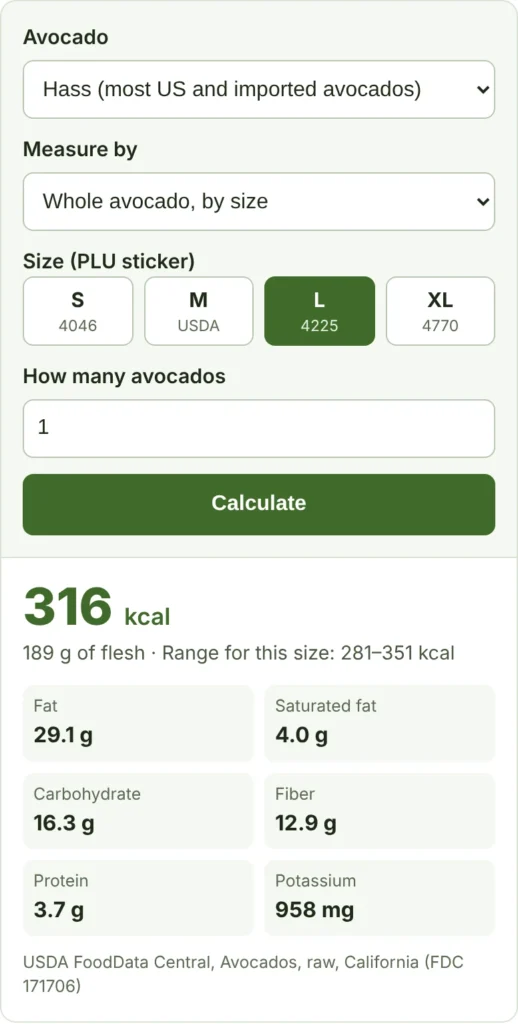
IMAGE HERE → avocado-calorie-calculator-large-hass.webp
Avocado nutrition facts (per 100 g, per serving and per whole fruit)
Per 100 g, Hass avocado has 167 calories, 15.4 g of fat (2.1 g saturated fat), 8.6 g of carbohydrate, 6.8 g of fiber, 2.0 g of protein, 507 mg of potassium and 0 mg cholesterol (USDA FoodData Central, FDC 171706). The table below scales those values to a 50 g serving and a whole fruit.
| Nutrition facts | 50 g (1 serving) | 100 g | 1 whole Hass (136 g) | %DV, whole fruit |
|---|---|---|---|---|
| Calories | 84 | 167 | 227 | n/a |
| Total fat | 7.7 g | 15.4 g | 21.0 g | 27% |
| Saturated fat | 1.1 g | 2.1 g | 2.9 g | 14% |
| Cholesterol | 0 mg | 0 mg | 0 mg | 0% |
| Sodium | 4 mg | 8 mg | 11 mg | 0% |
| Total carbohydrate | 4.3 g | 8.6 g | 11.8 g | 4% |
| Dietary fiber | 3.4 g | 6.8 g | 9.2 g | 33% |
| Total sugars | 0.2 g | 0.3 g | 0.4 g | n/a |
| Protein | 1.0 g | 2.0 g | 2.7 g | 5% |
| Potassium | 254 mg | 507 mg | 690 mg | 15% |
%DV uses FDA adult Daily Values, including 78 g fat, 20 g saturated fat, 28 g fiber, 50 g protein and 4,700 mg potassium (FDA).
Two rows stand out. Fiber covers 6.8 of the 8.6 g of carbohydrate, so the sugar and starch left over come to under 2 g per 100 g. And 690 mg of potassium per fruit is 15% of the Daily Value, which matters if you have kidney disease and a potassium limit.
How much protein is in an avocado?
A whole Hass avocado has 2.7 g of protein, and 100 g has 2.0 g (USDA FDC 171706). Protein supplies under 5% of an avocado’s calories, and a whole fruit covers about 5% of the Daily Value. Avocado does have protein, but it is a fat-rich fruit and a poor protein source, so count it as fat.
- Per 100 g: 2.0 g protein
- Per whole Hass avocado (136 g): 2.7 g
- Per 50 g serving: 1.0 g
To get 20 g of protein from avocado alone you would eat seven or eight fruits, about 1,700 calories. Pair it with eggs, beans or yogurt if protein is the goal, or pick from high-protein foods, ranked per calorie.
How much fiber is in an avocado?
A whole Hass avocado has 9.2 g of dietary fiber, about a third of the 28 g Daily Value (USDA FDC 171706; FDA Daily Values). One 50 g serving gives 3.4 g, or 12% DV, which meets the FDA threshold for a good source of fiber.
Under FDA labeling rules, a “good source” claim needs 10–19% of the Daily Value per serving (21 CFR 101.54).
Fiber also explains why the carbohydrate line looks bigger than the sugar line. Most of the carbohydrate is fiber that your gut does not absorb as glucose.
What kind of fat is in an avocado?
Most of the fat in avocado is monounsaturated. Per 100 g of Hass flesh, USDA lists 9.8 g of monounsaturated fat, 2.1 g of saturated fat and 1.8 g of polyunsaturated fats (USDA FDC 171706). A whole fruit carries about 13 g monounsaturated, 2.9 g saturated and 2.5 g polyunsaturated fat.
| Fat type (USDA FDC 171706) | Per 100 g | Per whole Hass (136 g) |
|---|---|---|
| Monounsaturated | 9.8 g | 13.3 g |
| Saturated | 2.1 g | 2.9 g |
| Polyunsaturated | 1.8 g | 2.5 g |
| Total fat | 15.4 g | 21.0 g |
The three types add up to less than total fat, because USDA counts some lipid material in total fat that falls outside the three fatty-acid groups.

The main monounsaturated fat is oleic acid, the same one that dominates olive oil. Avocado oil is the same fat with the water and fiber removed, at 884 calories per 100 g (USDA FDC 173573).
People call these healthy fats. Their effect on LDL cholesterol and blood pressure is a health question this page leaves aside.
Avocado macros: how its calories split between fat, carbs and protein
About 83% of a Hass avocado’s calories come from fat, 5% from protein and 4% from net carbohydrate, using USDA’s 167 calories per 100 g as the total (FDC 171706). Fat dominates because each gram carries 9 calories. Those shares add up to roughly 92%, not 100%, and the reason is in how the calories were calculated.
| Macro (per 100 g) | Grams | Calories at 4 / 9 / 4 | Share of the listed 167 kcal |
|---|---|---|---|
| Fat | 15.4 g | 139 | ~83% |
| Protein | 2.0 g | 8 | ~5% |
| Net carbs (carbs minus fiber) | 1.8 g | 7 | ~4% |
Multiply fat, protein and total carbohydrate by the general 9, 4 and 4 factors and you get 181 calories, not 167. USDA calculated the 167 figure with food-specific Atwater factors, so the simple sum overshoots. Treat these percentages as approximate, and expect small differences between apps.
The job each macro does in your body is covered in what fat, carbs and protein each do.
Avocado calories per gram, ounce, cup, tablespoon and slice
Hass avocado has 1.67 calories per gram, so 50 g has 84 calories, 1 oz has 47 and a tablespoon of mashed avocado has about 24 (USDA FDC 171706). A cup of mashed Hass avocado (230 g) has 384 calories. A kitchen scale beats a cup measure for accuracy.
| Amount | Weight | Calories | Record |
|---|---|---|---|
| 10 g | 10 g | 17 | California (171706) |
| 30 g | 30 g | 50 | California |
| 50 g (1 FDA serving) | 50 g | 84 | California |
| 100 g | 100 g | 167 | California |
| 1 oz | 28.35 g | 47 | California |
| 2 oz | 56.7 g | 95 | California |
| 3 oz | 85 g | 142 | California |
| 1 tablespoon, mashed | 14.4 g | 24 | California (1/16 of 230 g cup) |
| ¼ cup, mashed | 57.5 g | 96 | California |
| 1 cup, mashed (pureed) | 230 g | 384 | California |
| 1 cup, cubed | 150 g | 240 | All commercial varieties (171705) |
| 1 cup, sliced | 146 g | 234 | All commercial varieties (171705) |
The California record lists no cubed or sliced cup, so those two rows use the all-commercial record at 160 calories per 100 g.
A single slice has no fixed weight, since a thin slice and a thick wedge are different amounts. Put the slice on a kitchen scale and multiply its weight in grams by 1.67.
Energy density, Hass avocado: 1.67 kcal per gram. Florida avocado: 1.20 kcal per gram.
What is a serving of avocado?
A serving of avocado is 50 g, about one-third of a medium avocado, with 84 calories. The FDA sets 50 g as the reference amount customarily consumed (RACC) for avocado (21 CFR 101.12). Nutrition Facts panels on avocado products round the calories to 80.
The serving size grew when the FDA updated serving sizes in 2016. Before that, a label serving was a fifth of a medium fruit, about 30 g (Avocados From Mexico retail dietitian toolkit). The USDA record still lists that 30 g “NLEA serving” at 50 calories, which is why some calorie-tracking apps still show a 50-calorie serving.
A serving is a labeling unit and says nothing about how much you should eat. Your daily need depends on your size and activity; work out how many calories you need in a day.
Hass vs Florida avocados: why calorie counts differ
Florida avocados have 120 calories per 100 g, against 167 for Hass, but a whole Florida fruit carries more calories because it is far larger. USDA lists 304 g of edible flesh and 365 calories for one Florida avocado, versus 136 g and 227 calories for one California Hass (USDA FDC 171707; FDC 171706).
| Per 100 g edible | Avocados, raw, California | Avocados, raw, all commercial varieties | Avocados, raw, Florida |
|---|---|---|---|
| FDC ID | 171706 | 171705 | 171707 |
| Calories | 167 | 160 | 120 |
| Fat | 15.4 g | 14.7 g | 10.1 g |
| Saturated fat | 2.1 g | 2.1 g | 2.0 g |
| Water | 72.3 g | 73.2 g | 78.8 g |
| Edible grams per fruit | 136 | 201 | 304 |
| Calories per fruit | 227 | 322 | 365 |
The difference per gram is mostly water. Florida flesh is about 79% water against 72% for Hass, which leaves less room for fat.
The all-commercial record sits between the two because it is a weighted blend, 86% California and 14% Florida. Its 201 g fruit matches neither avocado you are likely to buy, yet when a site quotes 322 calories for “one avocado,” this is the record it used.
What vitamins and minerals are in avocados?
A whole Hass avocado gives about 40% of the Daily Value for pantothenic acid, 30% for folate, 24% for vitamin K and 23% for vitamin B6, plus smaller amounts of vitamins C and E (USDA FDC 171706; FDA Daily Values). It has almost no sodium. That spread makes avocado nutrient dense for its fat content.
| Nutrient | Per 100 g | Per whole Hass (136 g) | %DV, whole fruit |
|---|---|---|---|
| Pantothenic acid (B5) | 1.46 mg | 2.0 mg | 40% |
| Folate | 89 µg DFE | 121 µg DFE | 30% |
| Vitamin K | 21 µg | 29 µg | 24% |
| Vitamin B6 | 0.29 mg | 0.39 mg | 23% |
| Vitamin E | 1.97 mg | 2.7 mg | 18% |
| Vitamin C | 8.8 mg | 12 mg | 13% |
| Potassium | 507 mg | 690 mg | 15% |
| Sodium | 8 mg | 11 mg | 0% |
| Lutein and zeaxanthin | 271 µg | 369 µg | no DV |
A whole fruit is a good source of vitamin K, which matters if you take warfarin: a steady intake matters more than a low one.
Avocado calories: quick answers
Avocado is high in calories for a fruit because about 83% of its energy comes from fat. Half a USDA medium Hass avocado has about 114 calories, it has under 2 g of net carbs per 100 g, and no official body sets a daily limit (USDA FDC 171706).
Is avocado high in calories?
Yes, for a fruit. At 167 calories per 100 g, Hass avocado is far more energy-dense than watery fruit. A 50 g serving is a moderate 84 calories.
Why is avocado so high in calories?
Fat: 15.4 g per 100 g, at 9 calories per gram.
How many calories are in half an avocado?
Half a USDA medium Hass avocado (68 g) has about 114 calories. Half of a 150 g industry-medium fruit has 125.
Are avocados carbs?
Avocado is mostly fat. Each 100 g has 8.6 g of carbohydrate, but 6.8 g of that is fiber, leaving about 1.8 g of net carbs. That small net figure is why avocado fits most low-carb and keto meal plans.
How many avocados can you eat a day?
No official limit exists. Your daily calorie budget and any potassium restriction set it, and eating past that budget daily leads to weight gain.
Why do some doctors say not to eat avocados?
Usually for two groups. People with advanced kidney disease may need to limit potassium, and people on warfarin need steady vitamin K intake.
Sources and method
I used the USDA “Avocados, raw, California” record as the default because it describes Hass fruit, the avocado most readers will be holding. The calculator multiplies your edible grams by that record’s per-100 g values. If you choose Florida, it switches to FDC 171707. If you weighed the whole fruit, it first removes USDA’s 26% refuse for skin and seed. Every number on this page traces back to a named record, so you can check it.
- USDA FoodData Central, SR Legacy: Avocados, raw, California (FDC 171706); Avocados, raw, all commercial varieties (FDC 171705); Avocados, raw, Florida (FDC 171707); Oil, avocado (FDC 173573)
- FDA, 21 CFR 101.12, reference amounts customarily consumed
- FDA, 21 CFR 101.54, nutrient content claims
- FDA, Daily Value on the Nutrition Facts label
- Hass Avocado Board, Love One Today: Hass avocado PLU codes and size bands
- Avocados From Mexico, nutrition brochure and retail dietitian toolkit (citing the Hass Avocado Board)
General nutrition information. If you have kidney disease or take warfarin, ask your clinician how avocado fits your diet.
Last reviewed: November 4, 2026