
By Dr. Muhammad Awais Rabbani, MBBS · Reviewed by Dr. Ahmed Humayon, MBBS · Updated 18 October 2026
Enter your sex, weight, drinks and the hours since your first drink. The calculator estimates your blood alcohol concentration (BAC) with the Widmark formula and shows how long until you drop under your legal limit and back to 0.00%.
Blood Alcohol Concentration Calculator
Estimate your BAC, time to the legal limit, and time to sober — updates as you type.
Add your drinks above to see an estimate.
Estimate only — never use this to decide whether to drive. Real BAC varies with genetics, hydration, medication, drinking pace and food. Impairment happens below every legal limit. If you've been drinking, don't drive.
This number cannot clear you to drive. Impairment starts below every legal limit, and your BAC can keep rising after your last drink (NIAAA). If you have been drinking, arrange another way home.
How does a BAC calculator work?
It applies the Widmark formula. The grams of alcohol you drank are divided by your body weight in grams times a body-water constant called r, multiplied by 100, and then the alcohol your liver has cleared since your first drink is subtracted. The result is grams of alcohol per 100 mL of blood, the % figure on a US police report.
Formula: BAC (%) = [alcohol (g) ÷ (body weight (g) × r)] × 100 − (0.015 × hours since first drink)
- Alcohol in grams: drink volume in mL × ABV × 0.789, the density of ethanol. One US standard drink holds 14 g.
- r: the share of your body weight that alcohol spreads into. This calculator uses 0.68 for men and 0.55 for women.
- 0.015 per hour: an average elimination rate. Measured rates in most drinkers fall between about 0.010 and 0.025, with heavy drinkers at the fast end (Jones, Forensic Sci Int 2010).
- Food setting: a meal slows absorption and lowers the peak. The tool scales absorbed alcohol to 92% for a light meal and 85% for a full one. That adjustment is our own rough approximation; no validated constant exists for it.
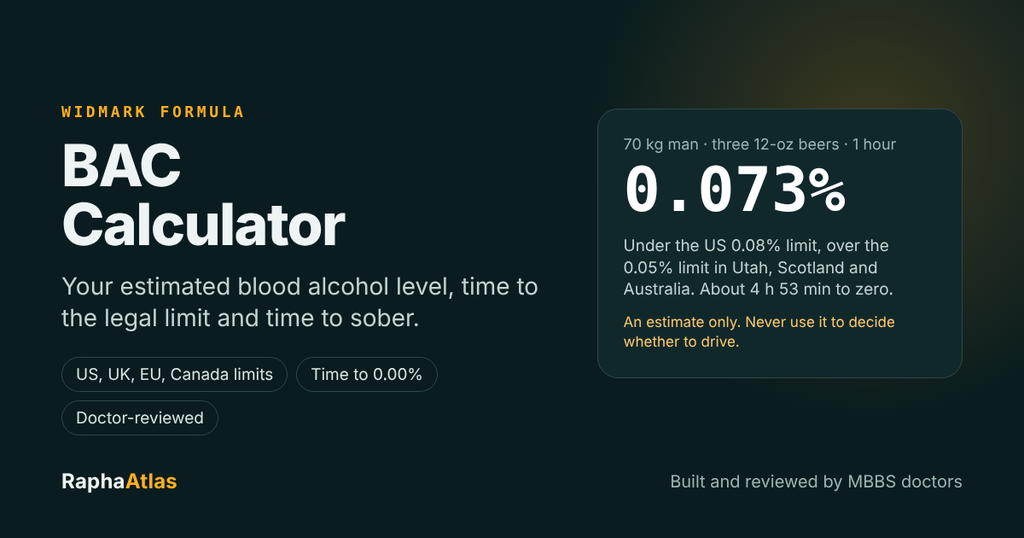
A worked example: a 70 kg (154 lb) man drinks three 12-oz beers at 5% ABV on an empty stomach. That is 42 g of alcohol. One hour after his first drink, 42 ÷ (70,000 × 0.68) × 100 − 0.015 gives 0.073%. He is under the US limit of 0.08% and over the 0.05% limit used in Utah, Scotland and Australia, and he needs about 4 hours 53 minutes to reach zero.
Why do BAC calculators give different answers?
Most of the gap comes from two constants. Some calculators use r = 0.73 for men and 0.66 for women, the values in the classic US version of the formula built on fluid ounces and pounds. Others, including this one, use 0.68 and 0.55. Some also subtract 0.017 per hour instead of 0.015.
| Same inputs (1 hour unless stated) | r = 0.68 / 0.55 (this tool) | r = 0.73 / 0.66 |
|---|---|---|
| Man, 70 kg, three 12-oz beers | 0.073% | 0.067% |
| Woman, 60 kg, two 5-oz glasses of wine | 0.070% | 0.056% |
| Man, 80 kg, four 1.5-oz shots, 2 hours | 0.072% | 0.065% |
For the woman in row two, the second set of constants takes 0.014 off her estimate. Either number is over a 0.05% limit, but the gap is wide enough to change a “time to legal limit” answer by about an hour. We use the lower r values because they give the higher, more cautious estimate.
What is one standard drink?
In the US, one standard drink contains 14 grams of pure alcohol, about 0.6 fl oz (NIAAA). Drinks that look very different can hold the same amount, and a single glass can hold two.
| Drink | Typical size | Typical ABV | Standard drinks |
|---|---|---|---|
| Regular beer | 12 fl oz (355 mL) | 5% | 1.0 |
| Malt liquor | 8–9 fl oz | 7% | 1.0 |
| Table wine | 5 fl oz (148 mL) | 12% | 1.0 |
| 80-proof spirits | 1.5 fl oz (44 mL) | 40% | 1.0 |
| Pint of regular beer | 16 fl oz (473 mL) | 5% | 1.3 |
| Pint of strong IPA | 16 fl oz (473 mL) | 9% | 2.4 |
The definition changes across borders. A UK unit is 8 g, an Australian standard drink is 10 g, and a Canadian one is about 13.5 g. Use the custom drink fields with the volume and ABV from the label and the calculator works in grams, so the country’s definition stops mattering.
How many drinks does it take to reach 0.08%?
About 3 US standard drinks for an average 70 kg (154 lb) man and between 2 and 3 for a 70 kg woman, one hour after the first drink on an empty stomach. Lighter people need fewer. The table uses this calculator’s formula.
| Body weight | Men | Women |
|---|---|---|
| 50 kg (110 lb) | 2.3 | 1.9 |
| 60 kg (132 lb) | 2.8 | 2.2 |
| 70 kg (154 lb) | 3.2 | 2.6 |
| 80 kg (176 lb) | 3.7 | 3.0 |
| 90 kg (198 lb) | 4.2 | 3.4 |
| 100 kg (220 lb) | 4.6 | 3.7 |
Treat these as averages for people of typical body composition. A muscular 90 kg man carries more body water than a 90 kg man with a higher body fat percentage, so he will read lower from the same drinks.
What is your BAC after 2 beers? For a 180 lb (82 kg) man, two 12-oz beers at 5% ABV give an estimated 0.035% one hour after the first drink. A 130 lb (59 kg) woman drinking the same two beers reaches about 0.071%, twice his level and over a 0.05% limit.
What BAC is legally drunk?
In every US state except Utah, driving with a BAC of 0.08% or higher is illegal on its own; Utah’s limit is 0.05% (Utah Code 41-6a-502). Commercial drivers are held to 0.04% (49 CFR 382.201), and every state applies a zero-tolerance limit of 0.02% or lower to drivers under 21 (NHTSA).
You can still be charged below these figures if an officer sees impaired driving. The limit marks where the law presumes impairment, and the impairment itself begins earlier.
| Place | General limit |
|---|---|
| United States | 0.08% (Utah 0.05%; commercial 0.04%; under 21, 0.02% or lower) |
| Canada | 0.08% criminal limit (Criminal Code s. 320.14); most provinces suspend licences from 0.05% |
| England and Wales | 0.08% |
| Scotland | 0.05% |
| Australia, most of the EU | 0.05% |
| India, Japan | 0.03% |
| Sweden, Norway, Poland | 0.02% |
International limits are from the WHO Global Status Report on Road Safety 2018. Many countries set lower limits for new and professional drivers, so check the rules for your licence.
What do different BAC levels do to you?
Effects start well before 0.08%. At 0.02%, driving skills that depend on dividing attention already decline, and by 0.05% steering and the response to an emergency get worse (NHTSA, The ABCs of BAC).
| BAC | Typical effects | Effect on driving |
|---|---|---|
| 0.02% | Some loss of judgment, relaxation, altered mood | Weaker visual function and divided attention |
| 0.05% | Exaggerated behaviour, lowered alertness, released inhibition | Reduced coordination, trouble steering, slower response to emergencies |
| 0.08% | Poor muscle coordination, impaired judgment, reasoning and memory | Short-term memory loss, poor speed control, reduced information processing |
| 0.10% | Clearly slower reaction time, slurred speech, slowed thinking | Trouble staying in lane and braking when needed |
| 0.15% | Far less muscle control, major loss of balance, vomiting possible | Substantial impairment in vehicle control and attention |
Source: NHTSA, The ABCs of BAC.
Higher up, blackouts tend to begin at around 0.16% (NIAAA). As the level keeps climbing, the brain areas that control breathing, heart rate and body temperature start to shut down. That is an alcohol overdose, and it can kill.
The colours in the calculator follow the same scale. Green covers readings under 0.03%, amber runs up to 0.08%, red marks 0.08% to 0.20%, and dark red marks anything above. Green describes a low reading. It does not mean safe to drive.
Why can my BAC keep rising after I stop drinking?
Alcohol still in your stomach and small intestine keeps passing into your blood after the glass is empty, so your BAC can go on rising after your last drink, even if you fall asleep or pass out (NIAAA).
This calculator assumes every drink is already absorbed. In the first hour after a round, your true BAC may sit below the figure shown and then climb toward it. Read the result as the level you are heading toward.
How long does it take to sober up?
Divide your BAC by 0.015 to get the hours to reach zero. At the average elimination rate, a BAC of 0.08% takes about 5 hours 20 minutes to clear and 0.15% takes about 10 hours.
| Starting BAC | Time to 0.00% |
|---|---|
| 0.05% | 3 h 20 min |
| 0.08% | 5 h 20 min |
| 0.10% | 6 h 40 min |
| 0.15% | 10 h |
| 0.20% | 13 h 20 min |
Coffee, a cold shower and drinking water do not speed this up (NIAAA). Neither does sleep. Someone who goes to bed at 2 a.m. with a BAC of 0.15% can still be over a 0.05% limit at 8 a.m., which is the morning-after risk.
Why do women reach a higher BAC than men from the same drinks?
On average, women have less body water per kilogram than men, so the same dose of alcohol ends up more concentrated in the blood. That is why r is 0.55 for women and 0.68 for men in this calculator. Women also tend to break down less alcohol in the stomach before it reaches the blood (Frezza et al., NEJM 1990).
The liver clears alcohol at a similar hourly rate in both sexes. The gap comes from how the alcohol spreads through the body.
What can’t a BAC calculator account for?
It runs on population averages, so medicines, liver health, body composition, drinking pace and tolerance can all move your real BAC away from the estimate. The main factors:
- Medicines and other drugs that interact with alcohol or add to its sedating effect
- Liver disease, which can slow elimination
- Body composition: two people of equal weight can hold very different amounts of body water
- Drinking pace: the formula treats all drinks as taken at the start
- Tolerance, which changes how drunk you feel without lowering your BAC
A breathalyzer measures alcohol in your breath. A calculator predicts it from inputs. Only a calibrated breath test or a blood test carries legal weight, and no online estimate is a defence in court.
When is drinking a medical emergency?
Call emergency services (911 in the US) if someone who has been drinking is confused, cannot be woken, is vomiting, has a seizure or is breathing slowly. These are signs of alcohol overdose, which can be fatal (NIAAA). The full list:
- Confusion or stupor, or cannot be woken
- Vomiting
- Seizures
- Slow breathing (fewer than 8 breaths a minute) or gaps of 10 seconds or more between breaths
- Slow heart rate, clammy skin, or bluish or pale skin
- Very low body temperature, or no gag reflex
Do not wait for every sign to appear. Stay with the person, keep them on their side so they cannot choke on vomit, and do not give them coffee or a cold shower.
Method and sources
This calculator uses the Widmark formula with r = 0.68 (men) and 0.55 (women), an elimination rate of 0.015% per hour and 14 g per US standard drink. It gives an estimate for education only and is not medical or legal advice.
- Widmark EMP. Die theoretischen Grundlagen und die praktische Verwendbarkeit der gerichtlich-medizinischen Alkoholbestimmung. Berlin: Urban & Schwarzenberg; 1932.
- Jones AW. Evidence-based survey of the elimination rates of alcohol in human blood with respect to medicolegal issues. Forensic Sci Int. 2010;200(1–3):1–20.
- Frezza M, di Padova C, Pozzato G, et al. High blood alcohol levels in women: the role of decreased gastric alcohol dehydrogenase activity and first-pass metabolism. N Engl J Med. 1990;322(2):95–99.
- National Highway Traffic Safety Administration. The ABCs of BAC: A Guide to Understanding Blood Alcohol Concentration and Alcohol Impairment.
- National Institute on Alcohol Abuse and Alcoholism. What Is a Standard Drink?
- National Institute on Alcohol Abuse and Alcoholism. Understanding the Dangers of Alcohol Overdose.
- National Institute on Alcohol Abuse and Alcoholism. Interrupted Memories: Alcohol-Induced Blackouts.
- Federal Motor Carrier Safety Administration. 49 CFR 382.201, Alcohol concentration.
- Utah Code § 41-6a-502, Driving under the influence of alcohol.
- World Health Organization. Global Status Report on Road Safety 2018.