
By Dr. Muhammad Awais Rabbani, MBBS · Updated 24 October 2026 · Editorial policy
Most adult women need 1,600 to 2,400 calories a day and most men 2,000 to 3,000, depending on age and activity (Dietary Guidelines for Americans 2020–2025). Enter your details below for your own maintenance number.
Calorie calculator
Only fill this in from a real measurement. It switches the calculator to the Katch-McArdle formula.
Your result is maintenance: the calories that hold your weight steady. Eat about 500 fewer to lose weight, or 300 to 500 more to gain.
How many calories should I eat a day?
Adult women need about 1,600 to 2,400 calories a day and adult men about 2,000 to 3,000. The low end fits sedentary adults over 50, and the high end fits active people in their twenties. These are the estimated calorie needs published in the Dietary Guidelines for Americans 2020–2025.
| Age and sex | Sedentary | Moderately active | Active |
|---|---|---|---|
| Women 19–30 | 1,800–2,000 | 2,000–2,200 | 2,400 |
| Women 31–50 | 1,800 | 2,000 | 2,200 |
| Women 51+ | 1,600 | 1,800 | 2,000–2,200 |
| Men 19–30 | 2,400–2,600 | 2,600–2,800 | 3,000 |
| Men 31–50 | 2,200–2,400 | 2,400–2,600 | 2,800–3,000 |
| Men 51+ | 2,000–2,200 | 2,200–2,400 | 2,400–2,800 |
In that table, moderately active means walking about 1.5 to 3 miles a day at 3 to 4 mph on top of normal daily life. Active means more than 3 miles. The figures assume an average height and weight for each age group, so a tall or heavy person will need more than the table shows, and a small person less.

Needs fall with age because muscle mass and activity usually fall with it.
What are maintenance calories?
Maintenance calories are the calories that keep your weight steady, also called total daily energy expenditure (TDEE). Eat that amount and your weight holds. TDEE has three parts, and a calculator estimates them because it cannot measure any of them.
- Basal metabolic rate (BMR): the energy your body uses at complete rest for breathing, circulation and keeping organs working. It is the largest share for most people and depends mainly on lean body mass, so it rises with weight and height and falls with age.
- Thermic effect of food: about 10% of the calories you eat are spent digesting them (Westerterp, Nutr Metab 2004).
- Activity: planned exercise plus everything else that moves you, such as walking, standing, chores and fidgeting. This is the part that differs most between two people of the same size.
Two people with identical height, weight and age can have maintenance numbers several hundred calories apart. The gap comes from muscle mass and daily movement, which no equation sees.
How does this calculator work out your number?
The calculator estimates your BMR with the Mifflin-St Jeor equation, then multiplies it by an activity factor between 1.2 and 1.9. A 2005 systematic review found Mifflin-St Jeor the most reliable common equation for healthy adults with or without obesity (Frankenfield et al., J Am Diet Assoc 2005).
Mifflin-St Jeor equation (Mifflin et al., Am J Clin Nutr 1990) Men: BMR = 10 × weight (kg) + 6.25 × height (cm) − 5 × age + 5 Women: BMR = 10 × weight (kg) + 6.25 × height (cm) − 5 × age − 161
| Activity level | Factor | What it looks like |
|---|---|---|
| Sedentary | 1.2 | Desk job, little exercise |
| Lightly active | 1.375 | Exercise 1–3 days a week |
| Moderately active | 1.55 | Exercise 3–5 days a week |
| Very active | 1.725 | Hard exercise 6–7 days a week |
| Extra active | 1.9 | Daily training plus a physical job |
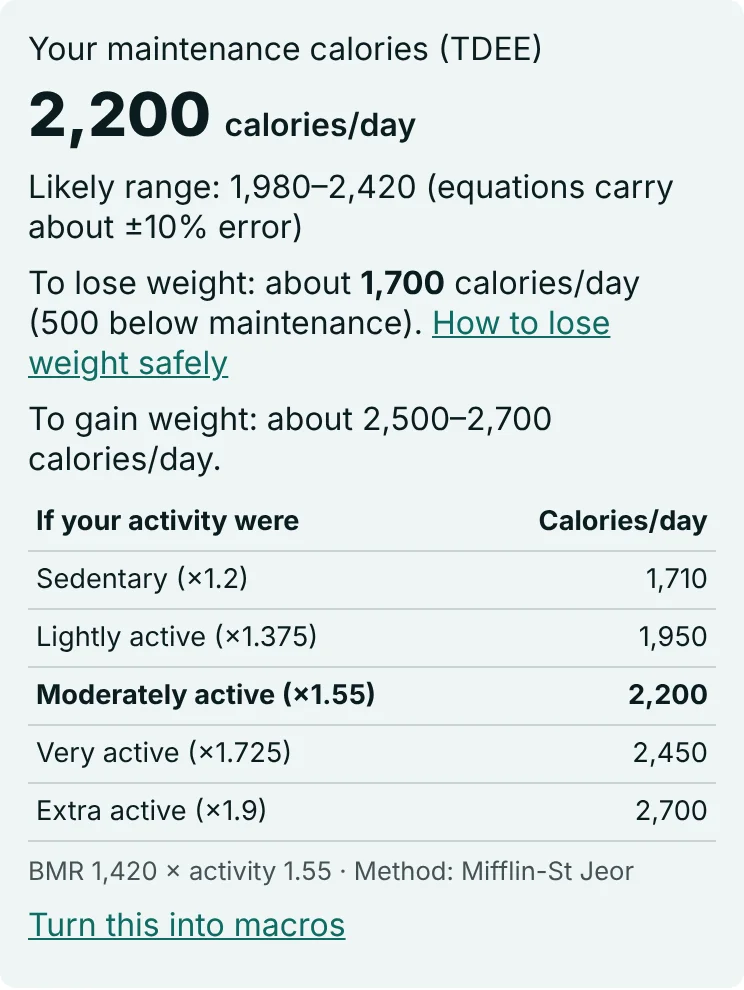
Here is one person run through it. A 35-year-old woman who is 5 ft 5 in (165.1 cm), weighs 160 lb (72.6 kg) and exercises 3 to 5 days a week has a BMR of 10 × 72.6 + 6.25 × 165.1 − 5 × 35 − 161, about 1,420 calories. Multiplied by 1.55, her maintenance is about 2,200 calories a day, with a likely range of 1,980 to 2,420. To lose weight she would eat about 1,700.
If you enter a measured body fat percentage, the tool switches to the Katch-McArdle equation (BMR = 370 + 21.6 × lean mass in kg), which works from lean mass directly. Enter body fat only from a real measurement such as a DEXA scan. A guessed figure adds error instead of removing it.
Results are rounded to the nearest 10 calories, because the equations are not precise enough to justify more.
How many calories should I eat to lose weight?
Eat about 500 calories a day below your maintenance number. At the start that loses roughly 1 lb a week. For adults, the 2013 US obesity guideline sets typical weight-loss intakes at 1,200 to 1,500 calories a day for women and 1,500 to 1,800 for men (Jensen et al., Circulation 2014).
The calculator holds to the bottom of that range.
It never suggests fewer than 1,200 calories for a woman or 1,500 for a man. If a 500-calorie cut would cross that line, it tells you to speak to a clinician instead of printing a number.
That floor matters most for smaller, older and less active people. A 60-year-old woman who is 152 cm (about 5 ft) and 50 kg (about 110 lb) and sits most of the day maintains on about 1,190 calories. A 500-calorie cut would put her at 690, far below a safe intake without medical supervision.
Why loss slows. The 500-calorie rule assumes 3,500 calories per pound of fat lost. That overpredicts loss after the first few months, because your maintenance number falls as your weight falls (Hall et al., Lancet 2011). Rerun the calculator every 10 lb or so.
Losing 1 to 2 lb a week is the pace the CDC links with keeping weight off (CDC, Losing Weight). To understand the energy math behind this, read what a calorie deficit is and why results slow down. To size a deficit around a goal weight and date, use the calorie deficit calculator.
How many calories should I eat to gain weight?
Eat about 300 to 500 calories a day above maintenance, which is the range the calculator prints. Weigh yourself on the same scale each morning and compare weekly averages. If the average has not moved after three weeks, add another 100 to 200 calories.
Pair a surplus with resistance training if you want the gain to be muscle rather than mostly fat.
If you are gaining weight without eating more, see a doctor before changing your calories. An underactive thyroid, fluid retention from heart or kidney disease, and medicines such as corticosteroids, insulin and some antidepressants can all add weight that a calorie target will not fix.
How accurate is a calorie calculator?
Treat the result as an estimate that can miss your true maintenance by 10% or more. The 2005 review that backed Mifflin-St Jeor found it predicted resting metabolism within 10% of measured values in more people than any other equation, but it still produced large errors for some individuals (Frankenfield et al., 2005). The same review noted that older adults and US ethnic minorities were underrepresented in the studies behind these equations.
That is why this calculator prints a range around your number. For the woman in the example, the true figure could sit anywhere from about 1,980 to 2,420 calories, and the equation cannot tell which.
Your own scale can. Three weeks of steady eating and daily weigh-ins turn the estimate into a measured number.
- Eat close to your estimated number for three weeks and log everything you eat, including oils and drinks.
- Weigh yourself every morning after the toilet and before eating, on the same scale.
- Ignore the first week. Early changes are mostly water and stored carbohydrate shifting, which says little about fat.
- Take your average weight for week 1 and for week 3. The difference is your change over 14 days.
- Your measured maintenance ≈ your average daily intake in weeks 2 and 3 + (pounds lost × 3,500 ÷ 14). If you gained, subtract instead.
Say the woman ate an average of 1,900 calories a day and her weekly average fell by 1 lb across those 14 days. Her measured maintenance is 1,900 + (1 × 3,500 ÷ 14) = 2,150 calories, 50 below the calculator’s estimate. From then on she plans with 2,150.
The food log is the weak link. A packaged food can legally contain up to 20% more calories than its label states (21 CFR 101.9(g)(5)), and people in one metabolic-ward study underreported their intake by 47% on average (Lichtman et al., NEJM 1992). A tracker that misses a daily tablespoon of cooking oil hides about 120 calories (USDA FoodData Central), which over 14 days looks like a slower metabolism.
Do you eat back calories burned from exercise?
Only if you chose sedentary as your activity level. The activity factor already includes your workouts, so adding the calories your watch reports on top counts the same exercise twice.
If you prefer to set activity to sedentary and log workouts one by one, add the net calories from each session, meaning the calories burned minus what you would have burned resting anyway. The calories burned calculator gives both figures for more than 100 activities, and the treadmill calorie calculator handles speed and incline.
Be wary of wrist-worn trackers here. In a Stanford study of seven devices, none measured energy expenditure within 20% of the lab reference, and errors ran as high as 93% (Shcherbina et al., J Pers Med 2017).
When should you not use this number?
The equations were built on healthy, non-pregnant adults, so the calculator withholds a number for teens and during pregnancy or breastfeeding, and its result is only a starting point for anyone with the conditions below.
- Pregnancy: the Dietary Guidelines add no extra calories in the first trimester, then about 340 a day in the second and 452 in the third. Your obstetrician or midwife sets the target.
- Breastfeeding: about 330 extra calories a day in the first 6 months and 400 in the second 6 months, per the same guidelines.
- Under 18: growth adds to calorie needs, and a deficit can affect growth. A teen’s doctor should set any target.
- Kidney, liver or heart disease, cancer treatment, or recent surgery: illness and healing change energy and protein needs. A dietitian working with your doctor should set the number.
- Diabetes treated with insulin or a sulfonylurea: cutting calories without adjusting medicine can cause low blood sugar. Talk to your prescriber first.
- GLP-1 medicines such as semaglutide or tirzepatide: appetite can drop so far that you eat well below this number without trying. Ask your prescriber about a minimum protein intake.
- A history of an eating disorder: calorie targets can do harm. The National Alliance for Eating Disorders helpline, (866) 662-1235, connects you with a licensed therapist.
What should those calories be made of?
Two diets with the same calories can feel very different, because protein, fiber and fat change how full you stay. Once you have your number, split your calories into protein, carbs and fat, or read what each macronutrient does first. Protein is the macro most worth getting right while losing weight, since it helps hold on to muscle. These high-protein foods, ranked per calorie, make the target easier to hit.
Calorie-dense whole foods add up fast. Raw avocado carries about 160 calories per 100 g (USDA FoodData Central), so check how many calories are in an avocado before adding one to every meal.
Fasting windows change when you eat more than how much. In a 12-month trial, time-restricted eating with calorie restriction led to no more weight loss than calorie restriction alone (Liu et al., NEJM 2022). See whether fasting is good for you for the rest of the evidence. If you have polycystic ovary syndrome, the PCOS diet guide covers how food choices interact with insulin resistance.
Method and sources
This calculator uses the Mifflin-St Jeor equation (or Katch-McArdle when you enter a measured body fat percentage), standard activity factors from 1.2 to 1.9, a ±10% range, a 500-calorie deficit and a 300 to 500-calorie surplus. It holds a floor of 1,200 calories for women and 1,500 for men, and gives no number for under-18s or during pregnancy and breastfeeding. It is an estimate for healthy adults, not medical advice.
- US Department of Agriculture and US Department of Health and Human Services. Dietary Guidelines for Americans, 2020–2025. 9th ed. December 2020. Appendix 2, Estimated Calorie Needs.
- Mifflin MD, St Jeor ST, Hill LA, et al. A new predictive equation for resting energy expenditure in healthy individuals. Am J Clin Nutr. 1990;51(2):241–247.
- Frankenfield D, Roth-Yousey L, Compher C. Comparison of predictive equations for resting metabolic rate in healthy nonobese and obese adults: a systematic review. J Am Diet Assoc. 2005;105(5):775–789.
- Jensen MD, Ryan DH, Apovian CM, et al. 2013 AHA/ACC/TOS guideline for the management of overweight and obesity in adults. Circulation. 2014;129(25 Suppl 2):S102–S138.
- Hall KD, Sacks G, Chandramohan D, et al. Quantification of the effect of energy imbalance on bodyweight. Lancet. 2011;378(9793):826–837.
- Westerterp KR. Diet induced thermogenesis. Nutr Metab (Lond). 2004;1(1):5.
- Shcherbina A, Mattsson CM, Waggott D, et al. Accuracy in wrist-worn, sensor-based measurements of heart rate and energy expenditure in a diverse cohort. J Pers Med. 2017;7(2):3.
- Liu D, Huang Y, Huang C, et al. Calorie restriction with or without time-restricted eating in weight loss. N Engl J Med. 2022;386(16):1495–1504.
- McArdle WD, Katch FI, Katch VL. Exercise Physiology: Nutrition, Energy, and Human Performance. Katch-McArdle equation.
- Lichtman SW, Pisarska K, Berman ER, et al. Discrepancy between self-reported and actual caloric intake and exercise in obese subjects. N Engl J Med. 1992;327(27):1893–1898.
- USDA FoodData Central: avocados, raw, all commercial varieties; oil, olive, salad or cooking.