By Dr. Muhammad Awais Rabbani, MBBS · Medically reviewed by Dr. Ahmed Humayon, MBBS · Updated October 23, 2026
Adults need about 91 oz (women) to 125 oz (men) of total water a day, and roughly 74 to 101 oz of that should come from drinks (IOM, 2005). Your number shifts with pregnancy, sweat and certain medical conditions.
Water intake calculator
Enter your age, sex and weight to get a drinks-only target in fluid ounces from Institute of Medicine figures, plus sweat-loss replacement if you log a workout. Weight feeds the rules comparison, not the target, because no adult guideline scales intake by weight. Conversions use 29.57 mL per fl oz.
How many oz of water a day do women and men need?
Healthy adult women need about 74 oz of fluid intake from drinks a day and men about 101 oz. That is the Adequate Intake in the Dietary Reference Intakes set by the Institute of Medicine, now the National Academy of Medicine (IOM, 2005). Total water, including food, is 91 oz for women and 125 oz for men.
| Group (19+) | Total water | Drinks-only target |
|---|---|---|
| Women | 2.7 L (91 oz) | 2.2 L (74 oz) |
| Men | 3.7 L (125 oz) | 3.0 L (101 oz) |
| Pregnant | 3.0 L (101 oz) | 2.3 L (78 oz) |
| Breastfeeding | 3.8 L (128 oz) | 3.1 L (105 oz) |
| EFSA 2010, women / men | 2.0 / 2.5 L (68 / 85 oz) | — |
An Adequate Intake reflects what healthy people already drink (IOM, 2005). A woman whose daily water intake from drinks is 80 oz sits above hers.
Pregnant or breastfeeding? Use the higher rows.
How many oz of water a day by weight?
There is no official weight-based rule for healthy adults. The IOM and EFSA set one figure per sex, whatever your body weight. The 8×8 rule of eight-ounce glasses has no scientific basis (Valtin, 2002), and the half-your-body-weight rule traces to no published study.
| Body weight | 8×8 rule | Half-your-body-weight rule | NICE CG174 maintenance fluids* | IOM drinks-only (woman / man) |
|---|---|---|---|---|
| 120 lb | 64 oz | 60 oz | 46–55 oz | 74 / 101 oz |
| 150 lb | 64 oz | 75 oz | 58–69 oz | 74 / 101 oz |
| 180 lb | 64 oz | 90 oz | 69–83 oz | 74 / 101 oz |
| 220 lb | 64 oz | 110 oz | 84–101 oz | 74 / 101 oz |
| 260 lb | 64 oz | 130 oz | 100–120 oz | 74 / 101 oz |
*25–30 mL/kg/day of IV fluid for adults in hospital, shown for scale only, never as oral advice (NICE, 2013).
The half-your-body-weight rule asks for more than the hospital range at every weight shown, and from 150 lb up it exceeds a woman’s IOM drinks figure. The 8×8 rule, eight glasses of water, falls below the IOM figure for every adult. Both rules are arbitrary; neither harms a healthy person.
Do food, coffee and tea count toward your total?
Yes. About 20% of total water comes from food and the rest from drinks, and every drink counts, coffee and tea included (IOM, 2005). That split is why the calculator shows a drinks-only target and a separate total.
Fruits and vegetables lead the water-rich foods:
- Cucumber and lettuce
- Watermelon and strawberries
- Soups and broths
- Yogurt and milk
How many oz of water a day for athletes and workouts?
Athletes need their baseline drinks-only target plus whatever they lose in sweat. For sweat-loss replacement, drink about 1.5 L for every kilogram of body weight lost during exercise, roughly 23 oz per pound (Sawka et al., 2007). Physical activity raises water loss without changing the baseline, and lifting to build muscle follows the same math.
- Weigh yourself before training, with minimal clothing.
- Train, towel off, and weigh again.
- Drink 23 oz for each pound lost over the next few hours.
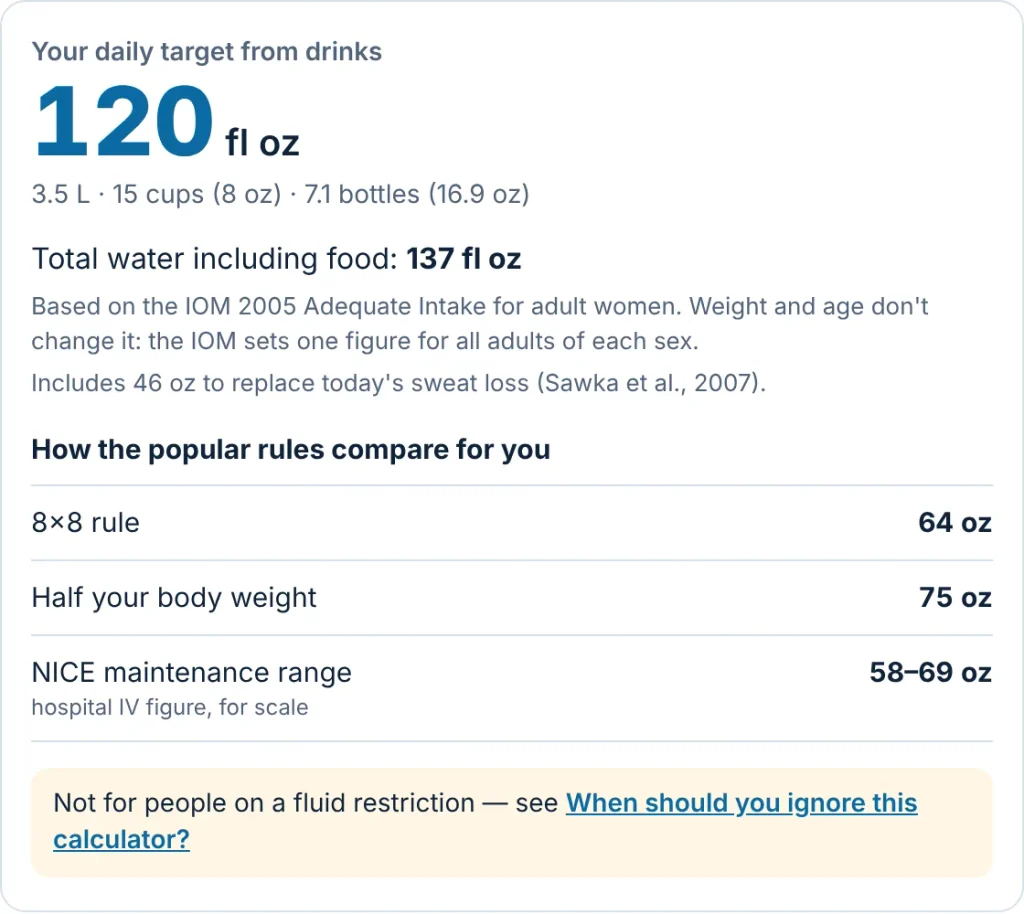
During long events, drinking far beyond sweat losses causes exercise-associated hyponatremia, so drink to thirst (Hew-Butler et al., 2015).
How do you know if you’re drinking enough?
You are drinking enough water when you rarely feel thirsty and your urine is pale straw in color. Dark amber urine means you need more (Armstrong et al., 1994). Dry mouth and fatigue, headache and fewer bathroom trips are the usual signs of mild dehydration.
Checking urine color daily helps prevent dehydration before symptoms start.
Older adults are the exception, because the thirst sense weakens with age (Kenney & Chiu, 2001). A drinking schedule serves them better than waiting for thirst. The ESPEN geriatric guideline sets a floor of 54 oz of drinks a day for women and 68 oz for men (Volkert et al., 2019), spread across meals to stay hydrated.
How many oz of water a day is too much?
For most healthy adults, 100 oz spread through the day is safe and sits within the IOM range for men. The danger comes from very large volumes in a short window, or when the body cannot clear water, which dilutes blood sodium and causes hyponatremia (Hew-Butler et al., 2015).
Healthy kidneys keep fluid balance across a wide range of intake (IOM, 2005). Some medicines raise the risk even at normal intake, most often thiazide diuretics and SSRIs (Liamis et al., 2008).
⚠️ Get urgent care for headache, nausea, vomiting or confusion after heavy drinking. Do not drink more to treat it (Hew-Butler et al., 2015).
When should you ignore this calculator?
Ignore this number if a doctor has set your fluid limit, or if a condition raises your needs. Heart failure, dialysis and hyponatremia often call for less fluid; kidney stones, fever, vomiting and diarrhea call for more, because these health conditions change how the body handles salt and water.
Physician-reviewed · Dr. Ahmed Humayon, MBBS
Drink less than the calculator says. Your doctor sets the limit.
- Heart failure: a fluid restriction of about 1.5–2 L a day may be advised in selected patients (McDonagh et al., 2021)
- Dialysis or advanced kidney disease: your nephrologist sets the volume
- Diagnosed hyponatremia
Drink more than the calculator says.
- Kidney stones: aim for a urine volume target of at least 2.5 L (85 oz) a day, which takes more than 85 oz of drinks (Pearle et al., 2014)
- Fever, vomiting and diarrhea
Will drinking more water help you lose weight?
Drinking more water helps modestly when paired with a calorie-controlled diet. In a 12-week trial, adults who drank 500 mL (about 17 oz) before each meal lost more weight than adults on the diet alone (Dennis et al., 2010). Water consumption does not burn fat by itself, so the diet still does most of the work.
For lasting weight loss, set your calorie and protein targets first.
How do you hit your number each day?
Tie drinks to habits you already have so intake spreads throughout the day, which is also the safest pattern. Three anchors cover the target for most adults, with extra water on hot days or after a workout:
- A glass with every meal and snack
- One glass after each bathroom trip
- A marked bottle: four 16.9 oz bottles make 68 oz; six make 101 oz
The “10-gulp rule” from social media appears in no guideline cited on this page.
Sources
- Institute of Medicine (2005). Dietary Reference Intakes for Water, Potassium, Sodium, Chloride, and Sulfate. National Academies Press.
- EFSA Panel on Dietetic Products, Nutrition and Allergies (2010). Scientific Opinion on Dietary Reference Values for water. EFSA Journal 8(3):1459.
- NICE (2013, updated). Intravenous fluid therapy in adults in hospital (CG174).
- Sawka MN et al. (2007). ACSM Position Stand: Exercise and fluid replacement. Med Sci Sports Exerc 39(2):377–390.
- Hew-Butler T et al. (2015). Statement of the Third International Exercise-Associated Hyponatremia Consensus Development Conference. Clin J Sport Med 25(4):303–320.
- Pearle MS et al. (2014). Medical management of kidney stones: AUA guideline. J Urol 192(2):316–324.
- Volkert D et al. (2019). ESPEN guideline on clinical nutrition and hydration in geriatrics. Clin Nutr 38(1):10–47.
- McDonagh TA et al. (2021). 2021 ESC Guidelines for the diagnosis and treatment of acute and chronic heart failure. Eur Heart J 42(36):3599–3726.
- Liamis G et al. (2008). A review of drug-induced hyponatremia. Am J Kidney Dis 52(1):144–153.
- Valtin H (2002). “Drink at least eight glasses of water a day.” Really? Am J Physiol Regul Integr Comp Physiol 283(5):R993–R1004.
- Dennis EA et al. (2010). Water consumption increases weight loss during a hypocaloric diet intervention in middle-aged and older adults. Obesity 18(2):300–307.
- Kenney WL, Chiu P (2001). Influence of age on thirst and fluid intake. Med Sci Sports Exerc 33(9):1524–1532.
- Armstrong LE et al. (1994). Urinary indices of hydration status. Int J Sport Nutr 4(3):265–279.