
By Dr. Muhammad Awais Rabbani, MBBS · Medically reviewed by Dr. Ahmed Humayon, MBBS · Updated 4 November 2026 · Editorial policy
Collagen is the most abundant protein in mammals, a triple-helix fiber that gives skin, bone, tendons and cartilage their strength (Ricard-Blum, 2011). Collagen supplements have some trial support for knee pain, contested evidence for skin, one trial for bone, and no trials for hair.
Evidence at a glance (trials checked 4 November 2026)
| Knee osteoarthritis pain | Some |
| Skin elasticity and hydration | Contested |
| Bone density | Limited (1 trial) |
| Muscle (with training) | Limited |
| Hair | No trials found |
| Gut (“leaky gut”) | No trials found |
What does collagen do in your body?
Collagen holds your body together. It is the main structural protein of connective tissue, and its fibers give skin its firmness, bone its frame, and tendons and ligaments the strength to carry load. Collagens make up 25–30% of all the protein in the body (Paul et al., 2019).
Each molecule is three protein chains wound into a tight triple helix. Thousands of these molecules line up, stagger and cross-link into fibrils, and fibrils bundle into fibers. Depending on the tissue, the fibers are packed as parallel ropes, woven sheets or loose meshes, which is how the same protein makes a tendon stiff and the skin of your cheek soft.

What collagen does, tissue by tissue:
- Skin: types I and III in the dermis keep skin firm and support wound healing.
- Bone: type I collagen is the scaffold that calcium and phosphate mineralise onto.
- Tendons and ligaments: parallel fibers pass muscle force to bone and hold joints together.
- Cartilage and blood vessels: type II cushions joint surfaces, and collagen in vessel walls stops them overstretching.
Collagen does not work alone. Elastin lets skin and arteries spring back, and minerals harden the frame of bone. When doctors talk about collagen in the body, they mean a family of 28 related proteins (Ricard-Blum, 2011), each tuned to its tissue and renewed slowly by the cells living inside it.
Do collagen supplements work? The evidence by goal
Collagen supplements show some benefit for knee osteoarthritis pain in randomized controlled trials. For skin, pooled trials look positive, but a 2025 meta-analysis found the effect vanished in trials not funded by industry. Bone and muscle rest on one or two industry-funded trials each, and no trials test hair or gut claims.
| Goal | Grade | Form tested | Grams per day | Weeks | Who was studied | Key source |
|---|---|---|---|---|---|---|
| Knee osteoarthritis pain | Some | Hydrolyzed peptides | 10 g | 26 | 250 adults with knee osteoarthritis | Benito-Ruiz 2009; meta-analysis of 4 RCTs, 507 patients, all at high risk of bias (Lin 2023) |
| Knee osteoarthritis pain | Some | Undenatured type II collagen | 40 mg capsule | 26 | 191 adults aged 40–75, moderate to severe knee osteoarthritis | Lugo 2016 · industry-funded |
| Skin elasticity and hydration | Contested | Hydrolyzed peptides | 2.5–5 g | 8 | 69 women aged 35–55 (Proksch 2014); pooled trials mostly women | Pu 2023 (26 RCTs) positive; Myung & Park 2025 (23 RCTs): no effect in independent or high-quality trials |
| Bone mineral density | Limited | Collagen peptides | 5 g | 52 | 131 postmenopausal women with low bone density | König 2018 · industry-funded |
| Muscle mass and strength | Limited | Peptides plus resistance training 3 times a week | 15 g | 12 | 53 men with sarcopenia, mean age 72 | Zdzieblik 2015 · industry-funded |
| Hair | No trials found | — | — | — | No placebo-controlled trial of collagen alone | — |
| Gut (“leaky gut”) | No trials found | — | — | — | No human randomized trial | — |
Evidence last checked 4 November 2026. “Industry-funded” means the maker of the tested product paid for all or part of the trial.
Read the grades this way. “Some” means several double-blind, placebo-controlled trials and at least one systematic review point the same way, with flaws. “Contested” means the reviews disagree. “Limited” means a single trial or two. The skin row shows why funding matters. Pooling 26 trials, Pu and colleagues found clear gains in hydration and elasticity, yet Myung and Park, pooling 23 trials, found no benefit once they kept only trials without industry money or only high-quality trials.
That split does not prove the sponsored trials wrong. It means independent replication is missing, and for most rows here it still is.
The “Who was studied” column matters as much as the grade. A skin trial in women aged 35 to 55 tells you little about a 25-year-old man, and a knee trial in people with diagnosed osteoarthritis tells you little about a runner with sore knees after a long race. If you do not resemble the people in the trial, treat the grade as a ceiling on what you can expect.
The knee rows hide two different products. Undenatured type II collagen is taken as a 40 mg capsule, while hydrolyzed peptides are taken by the 10 g scoop, so a capsule and a scoop cannot be swapped. The capsule trial measured the WOMAC score, a questionnaire on knee pain, stiffness and daily function, and it beat both placebo and glucosamine with chondroitin at 180 days (Lugo et al., 2016). Its sponsor made the capsule.
Muscle needs its own caveat. In the sarcopenia trial, men who lifted weights and took collagen gained 4.2 kg of fat-free mass against 2.9 kg on placebo (Zdzieblik et al., 2015). In older women, whey raised muscle protein synthesis and collagen did not (Oikawa et al., 2020).
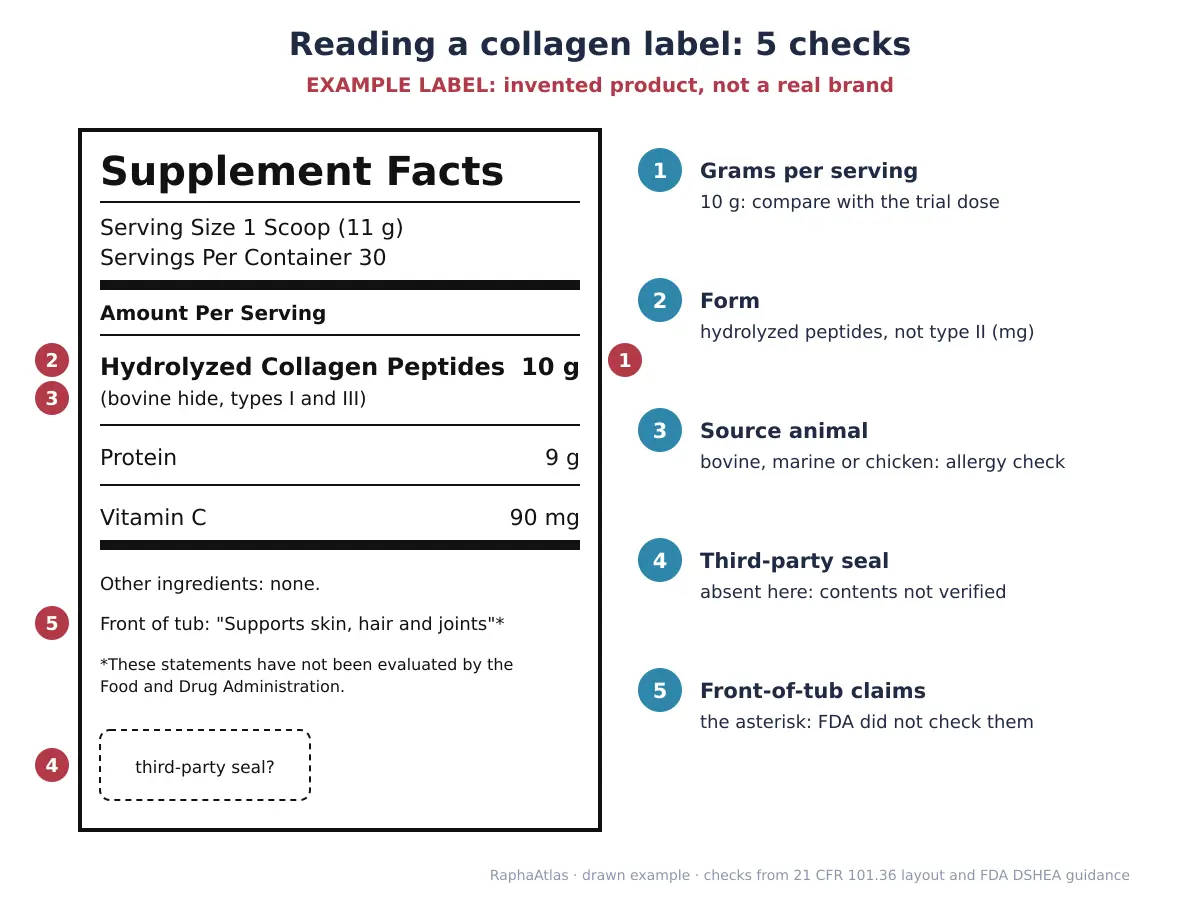
Check your label
- Grams per serving. Compare it with the trial dose for your goal in the table above.
- Form. Hydrolyzed peptides (gram doses) and undenatured type II (milligram doses) are different products.
- Source animal. Bovine, marine or chicken matters if you have a fish, shellfish or egg allergy.
- Third-party tested seal. Programs such as NSF Certified for Sport check that contents match the label and screen for unsafe contaminants (NSF).
- Front-of-tub claims. Under DSHEA, the Food and Drug Administration (FDA) is not authorized to approve supplements for safety or effectiveness before sale (FDA).
Now check your own tub. Enter the goal, form and collagen per serving from your label, and the checker sets them against the trial behind that goal, flags industry funding, and lists who should ask a doctor first.
Compares your label with published trials. It does not recommend a product or a personal dose.
Testing matters for animal-derived powders. In fish collagen supplements, arsenic and lead were detected, though no sample exceeded EU limits (Open Medicine, 2025).
This page does not recommend a product, rank brands or carry affiliate links.
What is collagen made of? Is it a protein?
Collagen is a protein built from amino acids, mostly glycine, proline and hydroxyproline in repeating groups of three. As food it is an incomplete protein, because it contains no tryptophan, one of the nine essential amino acids, which gives collagen a protein-quality score (PDCAAS) of zero (Paul et al., 2019).
| Amino acid | Where it sits | Why it matters |
|---|---|---|
| Glycine | Every third position in the chain | Small enough to fit the tight centre of the triple helix |
| Proline | Often the second position | Stiffens the chain |
| Hydroxyproline | Often the third position, made from proline with vitamin C’s help | Stabilises the helix; almost unique to collagen; partly broken down to oxalate |
A PDCAAS of zero needs context. Collagen powder still adds to your total protein grams, and Paul and colleagues calculated that collagen can supply a sizeable share of daily protein without unbalancing essential amino acids, as long as the rest comes from complete proteins. It cannot cover those needs on its own, and it is low in leucine, the amino acid that most strongly switches on muscle building. Pair it with protein foods that are complete proteins.
Hydroxyproline is the useful fingerprint here, and it is the reason people with kidney stones get a specific caution below.
Types of collagen
Researchers have described 28 types of collagen (Ricard-Blum, 2011). Type I builds skin, bone and tendons, type II cushions cartilage, and type III supports skin and blood vessels. Most supplements are made from bovine hide or fish skin, which are rich in types I and III.
| Type | Where it is | What it does | Common supplement source |
|---|---|---|---|
| I | Skin, bone, tendons, ligaments | Tensile strength | Bovine hide, fish skin |
| II | Joint cartilage | Cushions and resists compression | Chicken sternum (undenatured type II) |
| III | Skin, blood vessels, gut wall | Flexibility alongside type I | Bovine hide |
| IV | Basement membrane | Forms thin sheets under skin cells and in kidney filters | Not sold as a supplement |
| V | Cornea, placenta, alongside type I | Controls fiber thickness | Rarely named on labels |
Type II stands apart. Undenatured type II collagen is taken at milligram doses because it is thought to work through oral tolerance, where a tiny amount of intact protein teaches the gut’s immune system to calm its attack on joint cartilage (Lugo et al., 2016). Hydrolyzed type I and III peptides are digested into fragments, so the two products should be judged on separate evidence.
A “multi-collagen” label tells you which animal tissues went into the tub. It does not tell you the dose of each.
Collagen peptides, powder and other forms
Most collagen supplements are hydrolyzed collagen, also sold as collagen peptides. Hydrolysis cuts the long protein into short chains that dissolve in water. After a dose, the dipeptide Pro-Hyp (prolyl-hydroxyproline) is the main collagen fragment found in human blood, peaking one to two hours later (Iwai et al., 2005).
In the lab, Pro-Hyp makes human skin fibroblasts multiply and produce more hyaluronic acid (Ohara et al., 2010). That has not been shown inside people. So the picture of oral collagen supplements traveling intact to your face goes beyond the evidence: what reaches the skin is a set of amino acids and short peptides.
The forms you will see:
- Peptides: hydrolyzed, almost flavourless; the form used in most skin trials.
- Powder: usually the same peptides in a tub, which makes grams easy to measure.
- Liquid: shots and drinks, which often hold fewer grams per serving.
- Bovine: from cow hide, mainly types I and III.
- Marine: from fish skin and scales, type I; avoid it with a fish allergy.
Where does collagen come from?
Your body makes its own collagen. Fibroblasts in skin and connective tissue, along with bone and cartilage cells, assemble it from amino acids, and one key step needs vitamin C. The collagen in supplements comes from animal hides, bones and fish skin.
Collagen synthesis starts inside the cell as a longer precursor called procollagen. Vitamin C-dependent enzymes add hydroxyl groups to proline and lysine, three chains twist together, the cell releases them, and enzymes trim the ends so fibers can form outside the cell. Your body’s natural collagen production depends on that chain of steps, and on enough protein and vitamin C from a balanced diet.
Turnover is slow. Skin collagen has a half-life of about 15 years and cartilage collagen about 117 years (Verzijl et al., 2000), one reason any change from diet or supplements takes months to show.
Collagen-rich foods include bone broth, skin-on chicken and fish skin. Digestion breaks all of them into amino acids and short peptides.
Why collagen drops with age, and what low collagen looks like
Collagen production falls with age: fibroblasts from people over 80 made about a third less type I procollagen than those from people aged 18 to 29 (Varani et al., 2006). Sun exposure, smoking and menopause speed the loss. True collagen deficiency is rare, and wrinkles are normal signs of aging.
UV rays switch on matrix metalloproteinases (MMPs), enzymes that cut collagen in the dermis (Fisher et al., 1996). In smokers’ skin, type I and III collagen synthesis ran 18% and 22% lower than in non-smokers (Knuutinen et al., 2002). In women, up to 30% of skin collagen is lost in the first five years after menopause (Brincat et al., 1987).
Daily sunscreen has stronger evidence than any powder: in a 4.5-year randomized trial of 903 adults, daily users showed 24% less skin aging than discretionary users (Hughes et al., 2013).
Conditions where collagen itself fails:
- Scurvy: vitamin C deficiency stops collagen being made properly; bleeding gums, easy bruising and poor wound healing follow.
- Ehlers-Danlos syndrome: inherited defects in collagen or its processing; stretchy skin and loose, easily dislocated joints.
- Osteogenesis imperfecta: inherited type I collagen defects; bones break with little force.
None of these is treated with a collagen supplement. Scurvy is treated with vitamin C.
Should men take collagen? What about women?
Men can take collagen, though they have no special need for it. The evidence most relevant to men is a 12-week trial in older men with sarcopenia, where collagen plus weight training added fat-free mass and strength (Zdzieblik et al., 2015). Whey beat collagen for muscle building in a head-to-head trial (Oikawa et al., 2020).
If muscle is your goal, total daily protein matters more than which powder supplies it. Work out how many grams of protein you need and hit that number from food first. A man with knee osteoarthritis is the one whose situation best matches a trial, and even there the gains were modest.
For women, menopause is the turning point.
Skin trials enrolled mostly women, and the only bone trial studied postmenopausal women with low bone density (König et al., 2018). A woman in her fifties weighing collagen for skin or bone is closer to the trial populations than anyone else, and she should know that both rows lean on industry-funded work.
How much collagen should you take?
Collagen trials used 2.5 to 5 grams per day of hydrolyzed collagen for skin, 5 g for bone, 10 g for knee pain and 15 g with strength training for muscle. Undenatured type II collagen was tested at 40 mg a day. Outcomes were measured after 8 weeks to 12 months, so two weeks of use proves little.
Collagen peptides are already broken down, so heat from coffee or soup does not undo the hydrolysis. None of these trials compared morning with evening doses. Match your dose to the goal row in the evidence table, and to the form.
Side effects, and who should ask a doctor first
Collagen looks well tolerated in trials. The 180-day type II trial, built to test tolerability, found no safety problem (Lugo et al., 2016), and adverse events in the knee meta-analysis did not differ significantly from placebo (Lin et al., 2023). Risks concentrate in people with kidney stones or kidney disease, a fish, shellfish or egg allergy, and pregnancy.
Ask a doctor first if you have:
- Calcium oxalate kidney stones. In healthy adults, a gelatin-rich diet raised urinary oxalate by 43% compared with whey, and loads of 5 g and above changed oxalate excretion (Knight et al., 2006). No trial has measured stone risk directly, so the risk is theoretical, though worth a conversation.
- Fish, shellfish or egg allergy. Marine collagen comes from fish; check the source animal on the label.
- Pregnancy or breastfeeding. No trial in the table studied these groups.
- Kidney disease. Extra protein may need limiting; know what your creatinine result says about your kidneys and ask first.
Collagen still counts as protein. People on a protein-restricted diet for kidney or liver disease should include it in their daily limit. Many products add vitamin C, biotin, hyaluronic acid or herbal extracts, and those extras carry their own interactions and allergy risks, so read the whole ingredient list, not only the collagen line. A third-party tested product also lowers your exposure to heavy metals.
Frequently asked questions
What does collagen do to the body?
Collagen gives structure and strength to skin, bone, tendons, ligaments, cartilage and blood vessels.
Is collagen a protein?
Yes. Collagen is a structural protein made mostly of glycine, proline and hydroxyproline, and it makes up 25–30% of the body’s protein (Paul et al., 2019). As food it is incomplete because it lacks tryptophan, so it scores zero on PDCAAS and cannot replace complete protein foods such as eggs, dairy, meat or soy.
Do collagen supplements work?
For knee osteoarthritis pain, modestly, in trials with flaws. For skin, the reviews disagree once industry funding is accounted for. Hair and gut claims have no trials behind them.
Which food is rich in collagen?
Bone broth, skin-on chicken, fish skin and gelatin. Digestion breaks the collagen in all of them into amino acids and short peptides such as Pro-Hyp, so eating collagen supplies building blocks rather than finished collagen, and your body decides where those building blocks go.
What is the downside of taking collagen?
Mostly the cost against an uncertain benefit. People with calcium oxalate kidney stones, kidney disease or a fish allergy should ask a doctor first.
Collagen vs collagen peptides: what is the difference?
Collagen is the intact protein in your tissues. Collagen peptides are collagen cut into short chains by hydrolysis, so they dissolve in drinks. Most powders sold as “collagen” are peptides, and undenatured type II capsules are the main exception.
Sources and method
Every dose, duration and population in the evidence table and the label checker comes from the trial or review named in its row, read on 4 November 2026. I graded a goal “Some” only when several placebo-controlled trials and a systematic review agreed, and I flagged every trial its product maker paid for, because the skin reviews show that funding can change the answer. Last reviewed: 4 November 2026.
General information for adults. If you have kidney stones or kidney disease, a fish or egg allergy, or are pregnant or breastfeeding, ask your own doctor before taking collagen.
- Ricard-Blum S. The collagen family. Cold Spring Harb Perspect Biol 2011;3(1):a004978. doi:10.1101/cshperspect.a004978
- Paul C, Leser S, Oesser S. Significant amounts of functional collagen peptides can be incorporated in the diet while maintaining indispensable amino acid balance. Nutrients 2019;11(5):1079. doi:10.3390/nu11051079
- Pu SY, Huang YL, Pu CM, et al. Effects of oral collagen for skin anti-aging: a systematic review and meta-analysis. Nutrients 2023;15(9):2080. doi:10.3390/nu15092080
- Myung SK, Park Y. Effects of collagen supplements on skin aging: a systematic review and meta-analysis of randomized controlled trials. Am J Med 2025. doi:10.1016/j.amjmed.2025.04.034
- Proksch E, Segger D, Degwert J, et al. Oral supplementation of specific collagen peptides has beneficial effects on human skin physiology: a double-blind, placebo-controlled study. Skin Pharmacol Physiol 2014;27(1):47–55. PMID 23949208
- Benito-Ruiz P, Camacho-Zambrano MM, Carrillo-Arcentales JN, et al. A randomized controlled trial on the efficacy and safety of a food ingredient, collagen hydrolysate, for improving joint comfort. Int J Food Sci Nutr 2009;60(Suppl 2):99–113. doi:10.1080/09637480802498820
- Lin CR, Tsai SHL, Huang KY, et al. Analgesic efficacy of collagen peptide in knee osteoarthritis: a meta-analysis of randomized controlled trials. J Orthop Surg Res 2023;18:694. doi:10.1186/s13018-023-04182-w
- Lugo JP, Saiyed ZM, Lane NE. Efficacy and tolerability of an undenatured type II collagen supplement in modulating knee osteoarthritis symptoms: a multicenter randomized, double-blind, placebo-controlled study. Nutr J 2016;15:14. doi:10.1186/s12937-016-0130-8
- König D, Oesser S, Scharla S, Zdzieblik D, Gollhofer A. Specific collagen peptides improve bone mineral density and bone markers in postmenopausal women: a randomized controlled study. Nutrients 2018;10(1):97. doi:10.3390/nu10010097
- Zdzieblik D, Oesser S, Baumstark MW, Gollhofer A, König D. Collagen peptide supplementation in combination with resistance training improves body composition and increases muscle strength in elderly sarcopenic men: a randomised controlled trial. Br J Nutr 2015;114(8):1237–1245. doi:10.1017/S0007114515002810
- Oikawa SY, Kamal MJ, Webb EK, et al. Whey protein but not collagen peptides stimulate acute and longer-term muscle protein synthesis with and without resistance exercise in healthy older women: a randomized controlled trial. Am J Clin Nutr 2020;111(3):708–718. doi:10.1093/ajcn/nqz332
- Iwai K, Hasegawa T, Taguchi Y, et al. Identification of food-derived collagen peptides in human blood after oral ingestion of gelatin hydrolysates. J Agric Food Chem 2005;53(16):6531–6536. doi:10.1021/jf050206p
- Ohara H, Ichikawa S, Matsumoto H, et al. Collagen-derived dipeptide, proline-hydroxyproline, stimulates cell proliferation and hyaluronic acid synthesis in cultured human dermal fibroblasts. J Dermatol 2010;37:330–338. doi:10.1111/j.1346-8138.2010.00827.x
- Verzijl N, DeGroot J, Thorpe SR, et al. Effect of collagen turnover on the accumulation of advanced glycation end products. J Biol Chem 2000;275(50):39027–39031. doi:10.1074/jbc.M006700200
- Varani J, Dame MK, Rittie L, et al. Decreased collagen production in chronologically aged skin. Am J Pathol 2006;168(6):1861–1868. doi:10.2353/ajpath.2006.051302
- Fisher GJ, Datta SC, Talwar HS, et al. Molecular basis of sun-induced premature skin ageing and retinoid antagonism. Nature 1996;379:335–339. doi:10.1038/379335a0
- Knuutinen A, Kokkonen N, Risteli J, et al. Smoking affects collagen synthesis and extracellular matrix turnover in human skin. Br J Dermatol 2002;146(4):588–594. PMID 11966688
- Brincat M, Moniz CF, Kabalan S, et al. Br J Obstet Gynaecol 1987;94:126–129, as cited in Calleja-Agius J. Skin ageing (review, University of Malta). Read the review (PDF)
- Hughes MCB, Williams GM, Baker P, Green AC. Sunscreen and prevention of skin aging: a randomized trial. Ann Intern Med 2013;158(11):781–790. doi:10.7326/0003-4819-158-11-201306040-00002
- Knight J, Jiang J, Assimos DG, Holmes RP. Hydroxyproline ingestion and urinary oxalate and glycolate excretion. Kidney Int 2006;70(11):1929–1934. doi:10.1038/sj.ki.5001906
- Toxic metals and metalloids in collagen supplements of fish and jellyfish origin: risk assessment for daily intake. Open Med (Wars) 2025;20(1):20251141. doi:10.1515/med-2025-1141
- U.S. Food and Drug Administration. Information for consumers on using dietary supplements. fda.gov
- NSF. What our mark means: Certified for Sport. nsfsport.com