
By Dr. Muhammad Awais Rabbani, MBBS · Medically reviewed by Dr. Ahmed Humayon, MBBS · Updated 24 October 2026 · Editorial policy
Calories burned = MET × 3.5 × body weight (kg) ÷ 200 × minutes. A 70 kg person walking briskly for 30 minutes burns about 176 calories gross, or about 140 net once resting calories are subtracted. Pick an activity in this calorie burn calculator to see both numbers, the Compendium activity code behind them and the margin of error.
Use my resting rate (corrected MET)
Estimates for healthy adults aged 19–59, not a clinical energy prescription. Gross = MET × 3.5 × kg ÷ 200 × minutes. Net subtracts resting energy: the low end uses the standard 1 MET (1 kcal/kg/h), the high end the measured adult average of 0.84 kcal/kg/h (Byrne et al., 2005). MET values: 2024 Adult Compendium of Physical Activities.
Results are estimates for healthy adults, not a clinical energy prescription.
How to calculate calories burned (the MET formula)
Multiply the activity’s MET value by 3.5, then by your body weight in kilograms, divide by 200 and multiply by the minutes of exercise. The result is gross kilocalories (kcal), the unit food labels call calories. The MET values on this page come from the 2024 Adult Compendium of Physical Activities (Herrmann et al., 2024).
A MET, or metabolic equivalent of task, compares an activity with sitting at rest. One MET is defined as an oxygen consumption of 3.5 mL O₂/kg/min, which works out to roughly 1 kcal per kilogram of body weight per hour. Each litre of oxygen your muscles use releases about 5 kcal, and dividing by 200 folds that conversion into the formula (ACSM, 2021).
Worked example. Brisk walking at 3.5–3.9 mph is Compendium activity code 17200, rated 4.8 METs. For a 70 kg walker, 4.8 × 3.5 × 70 ÷ 200 = 5.88 kcal per minute, or 176 kcal over 30 minutes.
- Find the activity’s code and MET value in the Compendium.
- Convert body weight to kilograms (pounds ÷ 2.2).
- Apply the formula, then subtract one MET’s worth to get net calories.
I use the Compendium because each activity has a fixed code and a published energy cost you can check.
Gross vs net calories: which number should you count?
Count net calories if you are matching exercise against food. Gross calories include the energy your body would have spent anyway during those minutes; net calories subtract it. For a 30-minute brisk walk at 70 kg, that is 176 gross against 140 net, a 36-calorie gap that grows with every extra minute.
| Gross calories | Net calories | |
|---|---|---|
| Formula | MET × 3.5 × kg ÷ 200 × min | (MET − 1) × 3.5 × kg ÷ 200 × min |
| Includes resting burn | Yes | No |
| Best for | Comparing activities; total energy expenditure | Adding exercise to a calorie intake or calorie deficit plan |
| 70 kg, brisk walk, 30 min | 176 kcal | 140 kcal |

If you log calories consumed against a daily calorie target, add the net figure.
That target already includes your resting burn. The gap is widest for gentle activity. Slow walking at 2.0 mph is rated 2.8 METs, so one of those METs, more than a third of the total, is energy you would have spent sitting down. For a hard run at 10 METs, the resting share falls to a tenth. Many fitness watches split “active” from “resting” energy, and active energy is their version of net.
Calories burned walking (by pace, time and distance)
A 70 kg adult walking for 30 minutes burns about 103 calories at a slow 2.0 mph and about 202 at a very brisk 4.0 mph (Compendium values). A 40-minute walk at 3.0 mph burns about 186. Gross calories per 30 minutes, by pace in miles per hour:
| Pace (code · MET) | 60 kg | 70 kg | 80 kg | 90 kg |
|---|---|---|---|---|
| 2.0–2.4 mph (17152 · 2.8) | 88 | 103 | 118 | 132 |
| 2.5 mph (17170 · 3.0) | 95 | 110 | 126 | 142 |
| 2.8–3.4 mph (17190 · 3.8) | 120 | 140 | 160 | 180 |
| 3.5–3.9 mph (17200 · 4.8) | 151 | 176 | 202 | 227 |
| 4.0–4.4 mph (17220 · 5.5) | 173 | 202 | 231 | 260 |
| 4.5–4.9 mph (17230 · 7.0) | 221 | 257 | 294 | 331 |
A mile at 3.0 mph takes 20 minutes and burns about 93 calories gross, 69 net, at 70 kg.
Calories burned running (per mile, 5K and per hour)
Running burns about 1 kcal per kg per km of net energy, almost regardless of pace (Margaria et al., 1963). A 70 kg runner uses roughly 113 net calories per mile, 350 for a 5K and 700 for a 10K. Faster running raises the hourly burn because each hour covers more kilometres; the cost per kilometre barely moves.
| Pace per mile (code · MET) | 60 kg | 70 kg | 80 kg | 90 kg |
|---|---|---|---|---|
| 12:00 (12030 · 8.5) | 107 | 125 | 143 | 161 |
| 10:00 (12050 · 9.3) | 98 | 114 | 130 | 146 |
| 9:00 (12060 · 10.5) | 99 | 116 | 132 | 149 |
| 7:30 (12090 · 12.0) | 95 | 110 | 126 | 142 |
| 6:00 (12120 · 14.8) | 93 | 109 | 124 | 140 |
| Net per mile (1 kcal/kg/km rule) | 97 | 113 | 129 | 145 |
| Net per 5K / 10K | 300 / 600 | 350 / 700 | 400 / 800 | 450 / 900 |
Gross kcal per mile shown. The slowest pace sits about 15% higher because each mile takes longer.
How many calories does an 80 kg man burn?
An 80 kg man burns about 160 gross calories in 30 minutes of moderate walking, about 391 running at 6 mph and about 336 cycling at 12–14 mph (Compendium values). Subtract 42 calories from each for the net figure. The formula ignores sex, so an 80 kg woman gets the same estimate.
| Activity, 30 min at 80 kg (code · MET) | Gross kcal | Net kcal |
|---|---|---|
| Walking, 2.8–3.4 mph (17190 · 3.8) | 160 | 118 |
| Walking, brisk 3.5–3.9 mph (17200 · 4.8) | 202 | 160 |
| Running, 6 mph (12050 · 9.3) | 391 | 349 |
| Cycling, 12–13.9 mph (01030 · 8.0) | 336 | 294 |
| Swimming laps, freestyle, slow (18240 · 5.8) | 244 | 202 |
| Weight lifting, vigorous (02050 · 6.0) | 252 | 210 |
| Yoga, hatha (02150 · 2.3) | 97 | 55 |
| Standing quietly (07040 · 1.3) | 55 | 13 |
Calories burned in other workouts (cycling, swimming, lifting and more)
At 70 kg, 30 minutes burns about 103 calories in Pilates, 184 on an elliptical, 276 in a vigorous circuit class and 404 skipping rope (Compendium values). The calculator’s search adds hundreds more, from snow shoveling to tennis.
| Activity (code) | MET | kcal / 30 min at 70 kg |
|---|---|---|
| Cycling, 12–13.9 mph (01030) | 8.0 | 294 |
| Stationary bike, general (01200) | 6.8 | 250 |
| Swimming laps, freestyle, slow (18240) | 5.8 | 213 |
| Rowing machine, moderate, under 100 W (02071) | 5.0 | 184 |
| Elliptical, moderate (02048) | 5.0 | 184 |
| Stair treadmill (02065) | 9.3 | 342 |
| Rope skipping, general (02068) | 11.0 | 404 |
| Yoga, hatha (02150) | 2.3 | 85 |
| Pilates, general (02105) | 2.8 | 103 |
| Circuit training, vigorous (02040) | 7.5 | 276 |
Vigorous lifting is rated 6.0 METs for the whole session, rests included, about 221 calories per 30 minutes at 70 kg.
How many calories do you need to burn to lose a pound?
To lose weight, the classic answer is 3,500 calories per pound of fat, yet real loss runs slower than the 3,500-calorie rule predicts because the body adapts as weight falls (Hall et al., Lancet 2011). Treat 3,500 as a rough guide for the first weeks; over months, the same daily deficit buys less.
If the rule held, a 70 kg person would need about 12 and a half hours of brisk walking, at 140 net calories per half-hour, or about 31 miles of running to burn one pound. A lighter body also spends less on the same work, and adaptive thermogenesis lowers resting metabolic rate beyond what the lost weight explains (Rosenbaum & Leibel, 2010).
EPOC, the afterburn after a hard session, adds about 6–15% of the exercise’s net cost (LaForgia et al., 2006).
Why the scale moves less than the math. Appetite often rises with training. For sustainable weight loss, most of the calorie deficit has to come from diet; exercise protects muscle mass and helps you maintain a healthy weight.
Once you have a target, split your calories into macros.
How accurate are calorie burn calculators (and fitness watches)?
A MET calorie calculator gives the average cost for a body of your weight, and the Compendium’s own authors state it was not built to give the precise energy cost for one individual (Compendium of Physical Activities, 2024). Wrist trackers do no better. In a Stanford test of seven devices, none measured energy expenditure with an error under 20% (Shcherbina et al., 2017).
From most to least accurate:
- Indirect calorimetry measures oxygen in and carbon dioxide out, breath by breath. It is the lab standard for a single session.
- Doubly labeled water tracks two isotopes in urine over one to two weeks. It is the reference standard for total energy use in free-living daily life.
- A MET calculator returns the average for your weight.
- A fitness tracker or smartwatch combines heart rate and motion; even the best Stanford device was off by about 27% on average.

The 3.5 figure is the weak point. Across 769 adults, measured resting energy use averaged 0.84 kcal per kg per hour, so the standard 1 MET overstated it by about 20%, with body fat and age driving the gap (Byrne et al., 2005). That is the margin of error this calculator shows on the net figure: one end subtracts the standard resting cost, the other subtracts the lower measured average. For the brisk walk above, net lands at 140–147 kcal.

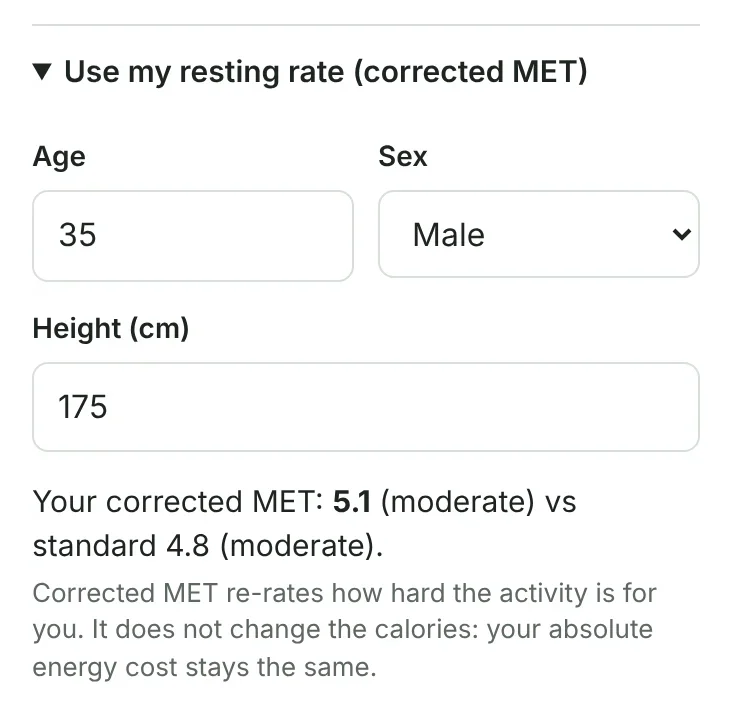
The same assumption distorts intensity. Measured against each person’s own resting rate, the standard MET understated activity intensity 89% of the time and put 12.2% of activities in the wrong intensity band, most often in older, heavier, less fit people and women (Kozey et al., 2010). A corrected MET adjusts for this: estimate your resting metabolic rate with the Harris–Benedict equation, convert it to mL O₂/kg/min, then multiply the activity’s MET by 3.5 and divide by your own figure. The resting-rate toggle shows yours.
Why two people burn different calories doing the same workout
Body weight explains most of the difference, because moving a heavier body costs more energy, and it is the only factor the standard formula sees. Body composition shifts the resting baseline, since lean body mass uses more energy at rest than fat; in one study of 769 adults it explained 62% of the variation in resting oxygen use (Byrne et al., 2005). Resting metabolic rate also tends to fall with age, and a higher fitness level means less wasted movement at the same exercise intensity.
NEAT (non-exercise activity thermogenesis) covers fidgeting, standing and walking, and can differ by up to 2,000 kcal a day between similar-sized people (Levine, 2002).
Do you burn more calories standing than sitting?
Yes, slightly. Standing burns about 0.15 kcal per minute more than sitting, roughly 9 extra calories an hour, according to a meta-analysis of 46 studies (Saeidifard et al., 2018). Over an 8-hour workday, that adds about 72 calories; short walks move the number faster.
| Per hour at 70 kg | Gross kcal | Net kcal |
|---|---|---|
| Sitting quietly (07021 · 1.0) | 74 | 0 |
| Standing (sitting + 0.15 kcal/min) | 83 | 9 |
| Walking, 2.0–2.4 mph (17152 · 2.8) | 206 | 132 |
Calories burned FAQ
How many calories does breastfeeding burn?
Making breast milk uses roughly 500 kcal a day in the first six months of exclusive breastfeeding (Butte & King, 2005). That cost comes from milk production, so no activity calculator measures it.
Does sitting in a sauna burn calories?
Very few. Sauna weight loss is mostly sweat, which returns when you rehydrate.
How many calories do I burn in a day?
A whole day adds resting metabolic rate, digestion, exercise and NEAT together, which is total daily energy expenditure. This calculator covers the exercise share only.
Sources and method
Every MET value and activity code comes from the 2024 Compendium. Net calories subtract one MET, with a second figure using the measured resting average. Written by a physician and medically reviewed; results are estimates for healthy adults.
- Herrmann SD, Willis EA, Ainsworth BE, et al. 2024 Adult Compendium of Physical Activities: a third update of the energy costs of human activities. J Sport Health Sci. 2024;13(1):6–12.
- Compendium of Physical Activities. Corrected METs – Adults. pacompendium.com/corrected-mets. Accessed 11 October 2026.
- American College of Sports Medicine. ACSM’s Guidelines for Exercise Testing and Prescription. 11th ed. Wolters Kluwer; 2021.
- Margaria R, Cerretelli P, Aghemo P, Sassi G. Energy cost of running. J Appl Physiol. 1963;18:367–370.
- Byrne NM, Hills AP, Hunter GR, Weinsier RL, Schutz Y. Metabolic equivalent: one size does not fit all. J Appl Physiol. 2005;99(3):1112–1119.
- Kozey S, Lyden K, Staudenmayer J, Freedson P. Errors in MET estimates of physical activities using 3.5 ml·kg⁻¹·min⁻¹ as the baseline oxygen consumption. J Phys Act Health. 2010;7(4):508–516.
- Shcherbina A, Mattsson CM, Waggott D, et al. Accuracy in wrist-worn, sensor-based measurements of heart rate and energy expenditure in a diverse cohort. J Pers Med. 2017;7(2):3.
- Hall KD, Sacks G, Chandramohan D, et al. Quantification of the effect of energy imbalance on bodyweight. Lancet. 2011;378(9793):826–837.
- Rosenbaum M, Leibel RL. Adaptive thermogenesis in humans. Int J Obes. 2010;34(Suppl 1):S47–S55.
- LaForgia J, Withers RT, Gore CJ. Effects of exercise intensity and duration on the excess post-exercise oxygen consumption. J Sports Sci. 2006;24(12):1247–1264.
- Levine JA. Non-exercise activity thermogenesis (NEAT). Best Pract Res Clin Endocrinol Metab. 2002;16(4):679–702.
- Saeidifard F, Medina-Inojosa JR, Supervia M, et al. Differences of energy expenditure while sitting versus standing: a systematic review and meta-analysis. Eur J Prev Cardiol. 2018;25(5):522–538.
- Butte NF, King JC. Energy requirements during pregnancy and lactation. Public Health Nutr. 2005;8(7A):1010–1027.