
SpO2: What It Means and What a Normal Blood Oxygen Level Is
By Dr. Muhammad Awais Rabbani, MBBS · Medically reviewed by Dr. Ahmed Humayon, MBBS · Updated 28 October 2026 · Editorial policy
SpO2 is the percentage of hemoglobin in your blood that is carrying oxygen, measured with a pulse oximeter. Most adults read 95% to 100% at rest (NHS); re-check a single low reading unless you feel unwell.
Short of breath at rest, chest pain or blue lips? Call 911 now.
Check your SpO2 reading
The SpO2 reading checker above takes the number on your device, the device it came from, who you are and any symptoms you have right now. It gives back one of four actions: fine, re-measure properly, contact a doctor today, or call 911.
The checker places your number in a band from the SpO2 reading guide below, then adjusts the advice for your device and your situation. Tick any red-flag symptoms and it tells you to call 911 whatever the number says, because a person struggling to breathe needs help even when the screen looks reassuring.
Choose lung disease with a target and it compares your number with that target instead of the adult range.
Nothing you enter is stored or sent anywhere. The bands come from NHS England’s home pulse oximetry guidance, written for people checking their oxygen at home during COVID-19 and still the clearest published home bands, and the lung-disease logic follows the British Thoracic Society (BTS).
What is SpO2?
SpO2 stands for peripheral oxygen saturation: S is saturation, p is peripheral, and O2 is oxygen. It is the percentage of hemoglobin in your red blood cells that is carrying oxygen, estimated by pulse oximetry at the finger or earlobe and shown on the device as a number with a % sign.
Hemoglobin is the protein inside red blood cells that picks up oxygen in the lungs and releases it in the tissues. Hemoglobin loaded with oxygen absorbs light differently from hemoglobin without it, so a pulse oximeter shines red and infrared light through your fingertip and measures how much of each gets through. It reads only the part of the signal that pulses with each heartbeat, which comes from arterial blood, and converts the ratio of the two lights into a percentage.
That is why it needs a steady pulse under the sensor.
“Sp02” is the same thing typed with a zero instead of the letter O. Hospital forms also write it as “O2 sat”.
SpO2 is an estimate. An arterial blood gas measures oxygen directly from an artery, and that result is written SaO2. The FDA reports that recently cleared prescription oximeters typically sit within 2 to 3 percentage points of blood gas values (FDA). The gap widens on a cold finger, in someone who is very unwell, and with darker skin, which the accuracy section covers.
What is a normal blood oxygen level?
A normal blood oxygen level for most adults at rest is 95% to 100% on a pulse oximeter (NHS). The British Thoracic Society gives about 96% to 98% for healthy young adults, a little lower with age. People with chronic lung disease may have a lower, doctor-set target.
| Who | Normal SpO2 | Source |
|---|---|---|
| Adult at rest | 95–100% | NHS (Walsall Healthcare NHS Trust) |
| Healthy young adult | about 96–98% | BTS 2017 |
| Over 70 and stable | some sit at 92–94% | BTS 2017 |
| Chronic lung disease, at risk of carbon dioxide build-up | usually 88–92%, set by your doctor | BTS 2017 |
| Child or newborn | outside this page; ask your child’s doctor | — |
What counts as normal depends on three things: who you are, the device, and what you were doing when you measured. A healthy adult’s number sits in a narrow band and barely moves with everyday activity. Someone with lung disease may live comfortably below that band on purpose.
A smartwatch on a moving wrist gives a less trustworthy number than a fingertip oximeter on a resting hand.
The average is high. In a study of 6,289 healthy people aged 1 to 80, the median reading near sea level was 99% (Rojas-Camayo et al., 2018), which is why two people can see the same 95% and need different advice about their oxygen levels.
SpO2 reading guide: what 100% down to 70% means
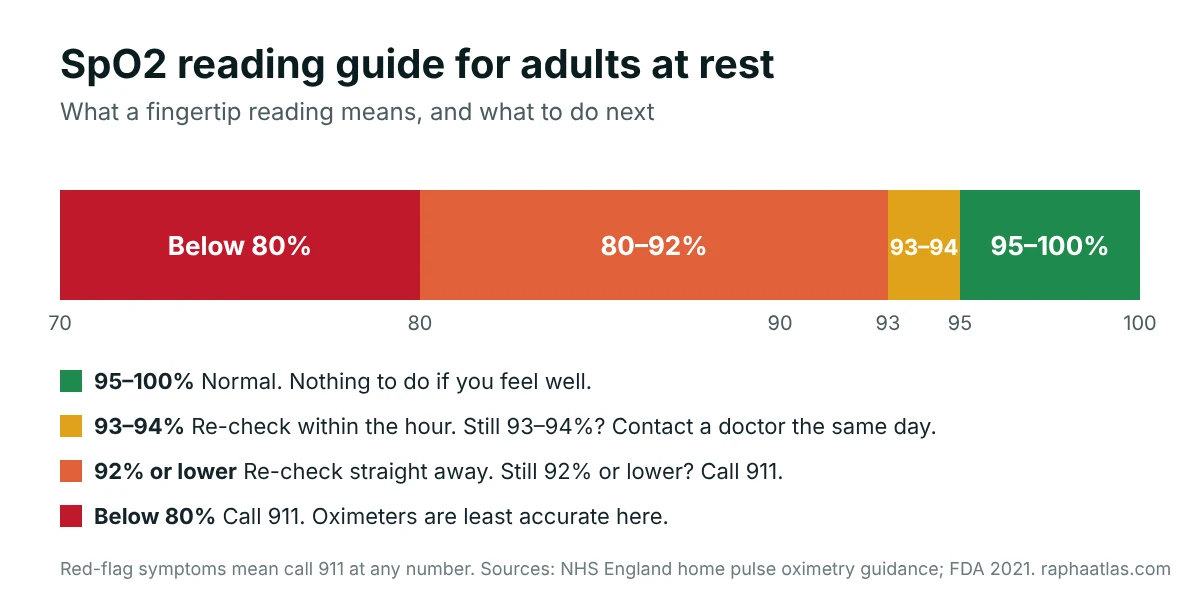
The SpO2 reading guide below shows what a single number usually means for an adult at rest and what to do next, using NHS England’s home monitoring bands. Symptoms come first: if you feel unwell, act on how you feel, whatever band the number falls in.
| SpO2 band | What it usually means for an adult at rest | What to do |
|---|---|---|
| 95–100% | Within the normal range | Nothing, if you feel well |
| 93–94% | Below the usual range | Re-check within the hour on a warm, still hand; if it stays at 93–94%, contact a doctor or urgent care the same day |
| 92% or lower | Low | Re-check straight away; if it is still 92% or lower, call 911 |
| Below 80% | Low, and the device is least accurate here | Call 911; do not wait for a better number |
If you have lung disease, your doctor may have set a different target. Follow that target instead of this table.
Searches such as “is 96 a good oxygen level”, “is 94 bad” or “what does 92 mean” all come down to which band the number falls in and who is reading it. A 96 sits in the top band. A 94 asks for a careful re-check, not panic.
Look at the trend as well as the single figure. The FDA advises basing decisions on readings over time rather than one absolute cut-off, and gives the example that a 90% reading can reflect a true saturation anywhere from about 86% to 94% (FDA). A number that slips below your usual over a day matters more than one dip on a cold finger.
How to get an accurate pulse oximeter reading
To get an accurate pulse oximeter reading, rest for 5 minutes, warm your hand, take off nail polish, keep the hand still, and wait for a steady waveform before you read the number. If one reading looks low and you feel well, re-measure before you act on it.
- Sit and rest for at least 5 minutes before you measure (NHS Vale of York).
- Warm your hands. Cold hands and poor circulation weaken the pulse signal the sensor needs (FDA).
- Remove nail polish or artificial nails from the finger you use, or switch fingers (NHS England).
- Keep your hand still, resting on your chest or a flat surface.
- Wait for a steady plethysmograph waveform, the wave or bar that rises with each heartbeat. The WHO Pulse Oximetry Training Manual explains that this display shows pulse strength, and the signal weakens when circulation is poor.
- Leave the device on until the number settles, then record the highest number once it has not changed for 5 seconds (Walsall Healthcare NHS Trust).
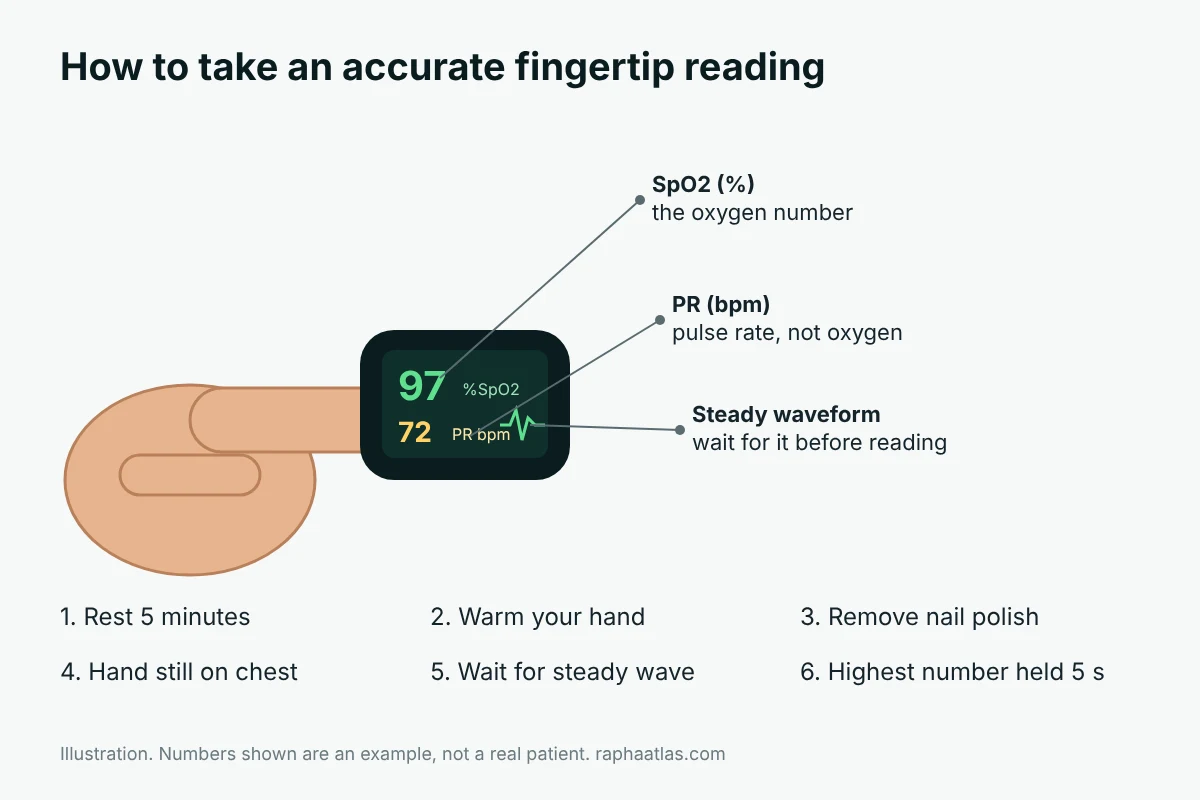
A single low number on a cold, moving finger is a common false alarm. Run the six steps again before you worry.
Some devices also show a perfusion index (PI), another measure of signal strength. A weak signal makes the SpO2 beside it less trustworthy, so warm the hand and re-measure.
Skin pigmentation affects accuracy. The FDA has warned that oximeters can be less accurate in people with darker skin (FDA). In a New England Journal of Medicine study (Sjoding et al., 2020), among patients whose oximeter read 92% to 96%, oxygen on an arterial blood test was below 88% in 11.7% of Black patients and 3.6% of White patients. That hidden gap is called occult hypoxemia.
If your skin is darker, treat a borderline number with extra care and let symptoms decide.
Carbon monoxide poisoning can give a falsely normal number, because a standard oximeter cannot tell carbon monoxide on hemoglobin from oxygen; abnormal hemoglobins are a recognized source of error (APSF). The FDA also lists current tobacco use among the factors that affect accuracy (FDA).
How to raise your SpO2
To raise your SpO2, first make sure the low number is real, then treat what is lowering it. Re-measure after 5 minutes of rest on a warm, still hand. If a proper reading still sits below your usual range, contact a healthcare provider, because the right fix depends on the cause.
- Re-measure with the six steps above. Many low numbers come from the device, not the lungs.
- Stop smoking. Smoke adds carbon monoxide to the blood, which carries less oxygen and fools the sensor.
- If you have been prescribed supplemental oxygen, use it at exactly the flow or target range your doctor set; the BTS asks for oxygen to be prescribed to a target (BTS).
- See a doctor to find and treat the cause, such as a chest infection, asthma or a flare of lung disease.
People searching for a medicine to increase their oxygen level are usually looking for a home fix. The things that work come from a doctor. Oxygen therapy raises SpO2 directly, and treating the cause raises it over hours to days: inhalers for asthma, antibiotics for some chest infections, or water tablets when fluid has built up in the lungs.
Products sold to “boost oxygen” are no substitute for that assessment.
If you are short of breath at rest while you try these steps, stop and call 911.
SpO2 targets with COPD or chronic lung disease
If you have COPD or another chronic lung disease, your doctor may give you a doctor-set target below the healthy adult range. The British Thoracic Society recommends 88% to 92% for people at risk of carbon dioxide building up in the blood, and 94% to 98% for most other acutely ill adults (BTS 2017).
In some people with long-standing lung disease, too much oxygen lets carbon dioxide collect in the blood. The BTS set 92% as the top of their range because that risk rose above the oxygen level matching about 92% (Paramedic Practice summary of BTS).
A higher number is not always better for these patients. That is why their oxygen therapy is prescribed to a target range, why some carry an oxygen alert card stating it, and why the checker asks for your own target.
Follow your own written target. If you don’t have one, ask for it at your next appointment.
SpO2 at altitude and during exercise
SpO2 falls at altitude because the air there has less oxygen pressure. In healthy residents of the Andes, the middle reading was 96% at 2,500 m (about 8,200 feet) and 90% at 3,950 m (Rojas-Camayo et al., 2018). Hard exercise can also lower it briefly in healthy people.
Those figures come from people who live at height, so a visitor’s number can differ. A lower reading on a ski trip with no symptoms is expected. Breathlessness at rest, a severe headache or confusion at altitude needs medical attention the same day, even when the number looks acceptable.
During exercise, researchers treat a fall of 4 points or more from rest as exercise-induced desaturation (Durand & Raberin, 2021), and healthy people often show it after intense effort (Seixas et al., 2013). Movement also blurs the signal, so re-measure once you have rested.
With asthma, follow your asthma action plan; SpO2 is one sign among several.
When is a low SpO2 an emergency?
A low SpO2 is an emergency when a proper reading is 92% or lower and stays there on an immediate re-check (NHS England), or at any number if you have red-flag symptoms. Symptoms override the screen, so call 911 for any of the signs below.
- Shortness of breath at rest
- Chest pain
- Confusion, agitation, or being hard to wake
- Blue or grey lips, face or tongue (cyanosis)
- Not being able to finish a short sentence without stopping to breathe
If a red-flag symptom is present, call 911. The number on the screen does not change that.
Hypoxemia, the medical word for too little oxygen in the blood, has many causes, from pneumonia and asthma attacks to blood clots in the lungs. Finding the cause is a job for a doctor with an examination and tests, so this page does not list them.
For someone who has felt well all day and gets one low number with no symptoms, the first step is to re-measure properly.
How a doctor reads your SpO2 number
A doctor reads an SpO2 number by looking at the person first and the screen second. They count the respiratory rate, check skin color, listen to whether the patient can speak in full sentences and look for a clean waveform, then decide how far to trust the number on the monitor.
Guidance for staff says the same thing. The AARC practice guideline states that an SpO2 result should match the patient’s clinical condition (AARC). The WHO Pulse Oximetry Training Manual notes that a “no pulse detected” alarm usually means the probe has slipped, but can also mean low blood pressure or cardiac arrest, so staff check the probe quickly and then assess the patient (WHO manual via PhenX).
If the number doesn’t fit the person, the next step is a re-check on a warm finger with a good waveform. When the decision matters, a doctor may order an arterial blood gas (ABG), which measures oxygen, carbon dioxide and acid levels from an artery and settles the question. Other tests follow the cause, such as a chest X-ray, a BNP blood test when heart failure is possible, a red blood cell count when anemia could be limiting how much oxygen the blood carries, or kidney blood tests such as creatinine when medicines or fluids are being adjusted.
NHS England’s home guidance pairs the number with how the person feels in the same way: worsening breathlessness or confusion triggers help whatever the oximeter shows.
SpO2 on a hospital monitor, a fingertip oximeter and a smartwatch
SpO2 on a hospital monitor, a fingertip oximeter and a smartwatch is the same measurement, made with red and infrared light. What differs is how far you can rely on it: prescription devices are FDA-reviewed and tested for accuracy, while devices sold for wellness are not meant for medical decisions (FDA).
| Device | Where it’s used | How much to trust it for decisions |
|---|---|---|
| Hospital monitor | Wards, emergency rooms, operating rooms | Highest of the three; staff check the waveform and the patient |
| Fingertip oximeter | Home monitoring | Useful when measured properly; check the labeling for its stated accuracy |
| Smartwatch or ring | Wellness tracking | Not for diagnosis or treatment decisions |
On a hospital monitor, SpO2 usually sits next to the heart rate from the ECG, and the oximeter shows its own pulse rate in beats per minute, often labeled PR. The two should match. If the oximeter’s pulse rate differs from the ECG heart rate, the probe is probably not picking up a good signal, and the SpO2 beside it is unreliable until it does.
On a home device, check which number is which before you write anything down.
Smartwatch numbers are meant for wellness. Confirm a low one on a fingertip oximeter before you act on it.
SpO2 FAQ
Is 100% SpO2 good?
Yes. In healthy people near sea level, 98% to 100% is common; the median in one large study was 99% (Rojas-Camayo et al., 2018). For hospital patients on supplemental oxygen, the BTS caps most targets at 98%, so staff may turn the flow down.
Is SpO2 a vital sign?
In practice, yes. The BTS asks for it to be charted beside pulse, blood pressure, temperature and respiratory rate (BTS 2008).
Is SpO2 the same as VO2 max?
No. SpO2 is the share of your hemoglobin carrying oxygen at one moment. VO2 max is the most oxygen your body can use during hard exercise, measured in milliliters per kilogram per minute. Fitness apps show both, which causes the mix-up.
Why does my SpO2 go up and down?
Usually because of the measurement: a moving hand, cold fingers, nail polish or a weak signal all shift the number (FDA). Re-measure with the six steps above before you read anything into the change.
Is a reading of 94 bad?
Not on its own. NHS England places 93–94% in the re-check band: measure again within the hour, and contact a doctor the same day if it stays there. With a doctor-set target, compare 94 with that target instead.
Sources
All accessed 28 October 2026.
- British Thoracic Society. O’Driscoll BR et al. BTS guideline for oxygen use in adults in healthcare and emergency settings. Thorax 2017;72(Suppl 1):ii1–ii90. Guideline page (status “Valid”): https://www.brit-thoracic.org.uk/quality-improvement/guidelines/emergency-oxygen · Web Appendix 5: https://brit-thoracic.org.uk/document-library/guidelines/emergency-oxygen/web-appendix-5-summary-for-ambulance-and-prehospital-settings
- O’Driscoll BR, Howard LS, Davison AG. BTS guideline for emergency oxygen use in adult patients. Thorax 2008;63(Suppl 6):vi1–vi68. https://thorax.bmj.com/content/63/Suppl_6/vi1
- Paramedic Practice. Guideline alert: British Thoracic Society emergency oxygen use in adult patients. https://www.paramedicpractice.com/articles/guideline-alert-british-thoracic-society-emergency-oxygen-use-in-adult-patients
- NHS England. Pulse oximeter easy read (2022). https://www.england.nhs.uk/coronavirus/wp-content/uploads/sites/52/2022/02/pulse-oximeter-easy-read-2022-digital.pdf
- NHS England. Self-monitoring COVID-19 diary, version 2 (January 2022). https://www.england.nhs.uk/coronavirus/documents/c1541-self-monitoring-covid-19-diary-v2-print-version-january-2022/
- NHS Vale of York. Pulse oximeter patient instructions. https://www.valeofyorkccg.nhs.uk/seecmsfile/?id=4818
- Walsall Healthcare NHS Trust. Pulse oximeter information leaflet (2023). https://www.walsallhealthcare.nhs.uk/wp-content/uploads/2023/02/Pulse-Oximeter-Information-Leaflet.pdf
- U.S. Food and Drug Administration. Pulse oximeter accuracy and limitations: FDA safety communication (19 February 2021). https://www.fda.gov/medical-devices/safety-communications/pulse-oximeter-accuracy-and-limitations-fda-safety-communication
- U.S. Food and Drug Administration. FDA In Brief: FDA warns about limitations and accuracy of pulse oximeters (19 February 2021). https://www.fda.gov/news-events/fda-brief/fda-brief-fda-warns-about-limitations-and-accuracy-pulse-oximeters
- Sjoding MW, Dickson RP, Iwashyna TJ, Gay SE, Valley TS. Racial bias in pulse oximetry measurement. N Engl J Med 2020;383:2477–2478. https://www.nejm.org/doi/full/10.1056/NEJMc2029240
- Anesthesia Patient Safety Foundation. APSF statement on pulse oximetry and skin tone (2021). https://www.apsf.org/article/apsf-statement-on-pulse-oximetry-and-skin-tone/
- World Health Organization. Pulse Oximetry Training Manual, protocol text reproduced by PhenX Toolkit. https://www.phenxtoolkit.org/protocols/view/91102
- American Association for Respiratory Care. Clinical practice guideline: pulse oximetry, protocol via PhenX Toolkit. https://www.phenxtoolkit.org/toolkit_content/archive/90000/091101_Protocol.docx
- Rojas-Camayo J et al. Reference values for oxygen saturation from sea level to the highest human habitation in the Andes in acclimatised persons. Thorax 2018;73(8):776–778. https://thorax.bmj.com/content/73/8/776
- Durand F, Raberin A. Exercise-induced hypoxemia in endurance athletes. Front Sports Act Living 2021. https://pmc.ncbi.nlm.nih.gov/articles/PMC8107360
- Seixas DM et al. Oxygen desaturation in healthy subjects undergoing the incremental shuttle walk test. J Bras Pneumol 2013. https://pmc.ncbi.nlm.nih.gov/articles/PMC4075871
— —