
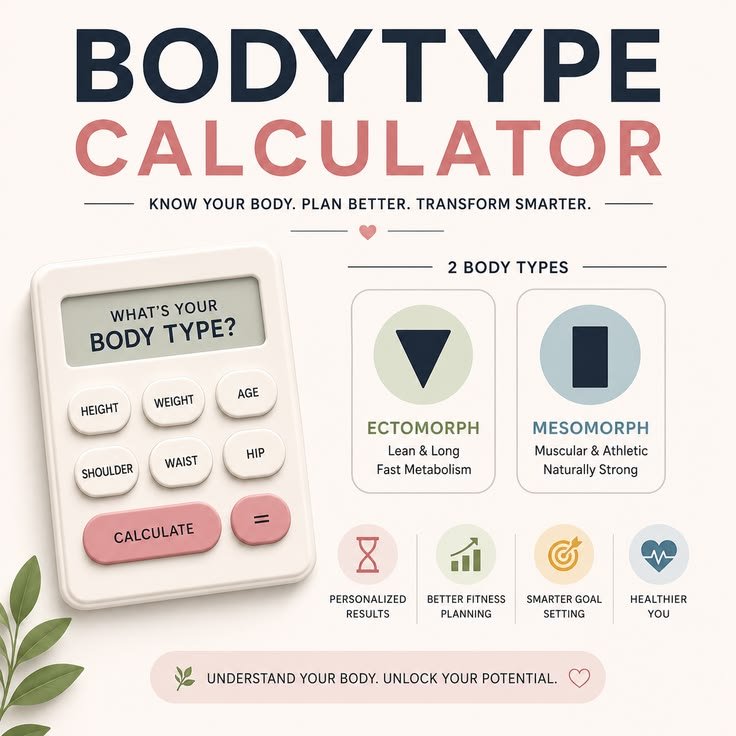
Enter your bust, waist, high hip and hip in inches or centimeters, and this body type calculator names your shape, shows the rule that decided it, tells you how far you are from the next shape, and flags results a half-inch tape error could flip.
Enter your measurements to find your body shape, how close you are to the next one, and your waist-to-hip ratio. Nothing is uploaded; the math runs in your browser.
Body shape describes measurement proportions, not health. The waist-to-hip note is a screening number, not a diagnosis; for anything health-related, talk to a doctor.
This body shape calculator sorts four tape measurements into one of seven female body shapes using ratio rules from FFIT, a published apparel-fit method. It then re-runs your numbers through the same rules to find how little any single measurement would have to move before the answer changes. The margin comes from the classifier itself, so it cannot disagree with your label. It is not a body fat calculator and does not estimate weight or health status.
What Body Type Am I? How to Read Your Result
Your result answers “what body type am I?” with a shape name, the rule that matched, and the distance to the next shape: the smallest change in one measurement that would produce a different shape. Results within 0.5 in (1.3 cm) of a shape threshold get a borderline flag. The distance tells you how much to trust the label.
Here is the calculator’s own output for one set of numbers (bust 36, waist 26.5, high hip 34, hip 37 in):
| Result line | What the calculator shows | What it means |
|---|---|---|
| Shape | Hourglass | Bust and hips within 1 in, hip minus waist at least 10 in |
| Rule matched | bust−hip ≤ 1, hip−bust < 3.6, and bust−waist ≥ 9 or hip−waist ≥ 10 | The exact FFIT line your numbers met |
| Nearest other shape | Rectangle, 0.6 in away (waist +0.6 in) | If your waist were 0.6 in larger, the hourglass rule would fail |
| Borderline flag | Not shown | 0.6 in is outside the 0.5 in margin |
| Waist-hip ratio | 0.72 | Health reading, explained further down |
Two people can both get “hourglass” while one sits 4 in inside the category and the other sits 0.1 in inside it. A plain label hides that difference. The margin shows whether the label is solid or whether one more tape reading could change it.
How to Measure Bust, Waist, High Hip, Hip and Shoulders
Use a soft measuring tape held parallel to the floor, snug against the skin without compressing it. Measure the bust at its fullest part, the waist at its narrowest part, the high hip across the top of the hip bones, and the hip at the widest part of the buttocks with your feet together.
| Measurement | Where the tape goes | Tape rule | Common mistake |
|---|---|---|---|
| Bust | Fullest part of the chest, over a thin non-padded bra | Level all the way round, under the arms | Tape drops lower across the back |
| Waist (natural waist) | Narrowest part of the torso, usually just above the belly button | Breathe out normally | Measuring at the belly button when the narrowest point is higher |
| High hip | Around the top of the hip bones, at the upper swell of the hip | Between the waist and the full hip | Confusing it with the waist |
| Hip | Widest part of the buttocks | Feet together, tape level front to back | Standing with feet apart |
| Shoulders (male mode only) | Around the widest point of both shoulders | Arms relaxed at your sides | Measuring across the front only |
The waist here is the fashion “natural waist.” Clinical waist circumference uses a different landmark: the WHO protocol places the tape midway between the lowest rib and the top of the iliac crest (WHO, Waist Circumference and Waist–Hip Ratio: Report of a WHO Expert Consultation, 2008), and the CDC’s anthropometric protocol measures just above the iliac crest (CDC, NHANES Anthropometry Procedures Manual). On many bodies these sites give different numbers.
Use the natural waist for your shape and the clinical site for the health figures below.
Take a repeat measurement of each site. The WHO protocol averages two readings that fall within 1 cm of each other and measures again when they differ by more (WHO, 2008).
The 7 Body Shapes and the Ratio Rules Behind Them
This calculator assigns one of seven shapes: hourglass, bottom hourglass, top hourglass, spoon, triangle (pear), inverted triangle and rectangle. They come from FFIT, the Female Figure Identification Technique, and each rule is a shape threshold in inches comparing bust, waist, high hip and hip.
FFIT was published by Simmons, Istook and Devarajan in 2004 in the Journal of Textile and Apparel, Technology and Management (vol. 4, issue 1) to sort female 3D body scans for clothing fit, and it was later run on SizeUSA, the national US sizing survey. The inch formulas below were published by Lee, Istook, Nam and Park (International Journal of Clothing Science and Technology, 2007) in a study comparing US and Korean women. FFIT was built for apparel fit and was never designed as a health measure.
| Order | Shape | Rule (inches; cm entries are converted at 1 in = 2.54 cm) |
|---|---|---|
| 1 | Hourglass | (bust − hip) ≤ 1 and (hip − bust) < 3.6, and (bust − waist) ≥ 9 or (hip − waist) ≥ 10 |
| 2 | Bottom hourglass | (hip − bust) ≥ 3.6 and < 10, (hip − waist) ≥ 9, high hip ÷ waist < 1.193 |
| 3 | Top hourglass | (bust − hip) > 1 and < 10, (bust − waist) ≥ 9 |
| 4 | Spoon | (hip − bust) > 2, (hip − waist) ≥ 7, high hip ÷ waist ≥ 1.193 |
| 5 | Triangle (pear) | (hip − bust) ≥ 3.6, (hip − waist) < 9 |
| 6 | Inverted triangle | (bust − hip) ≥ 3.6, (bust − waist) < 9 |
| 7 | Rectangle | (hip − bust) < 3.6, (bust − hip) < 3.6, (bust − waist) < 9, (hip − waist) < 10 |
The calculator checks the rules in this order and stops at the first match. If no rule matches, it returns the closest of hourglass, pear, inverted triangle or rectangle and says so on the result.
Hourglass
Bust and hip measurements are within about an inch of each other, and the waist is clearly narrower than both. This is the classic hourglass figure, also called the hourglass body type: a defined waist, with the upper body and lower body close to balanced. Because the rule has three conditions at once, a small change in any single tape reading can move a result into or out of this shape.
Bottom hourglass
Hips exceed the bust by 3.6 to just under 10 in, with a well-defined waist and a modest high hip.
The lower body carries more width, with a smooth curve from waist to hip.
Top hourglass
The bust is larger than the hips by more than 1 in and less than 10 in, and the waist sits at least 9 in below the bust. Width leads in the upper body.
A larger bust than hips separates it from a standard hourglass.
Spoon
The hips are more than 2 in larger than the bust, hip minus waist is 7 in or more, and the high hip is large relative to the waist, with a ratio of 1.193 or higher. That high hip measurement is the deciding number between spoon and bottom hourglass. A spoon shows a noticeable upper swell of the hip, sometimes described as a shelf just below the waist.
Triangle (pear)
The hips are at least 3.6 in larger than the bust, and the waist is less than 9 in smaller than the hips. A pear-shaped body, also listed as the triangle body shape, has wider hips and a narrower upper body, with a waist less sharply defined than in a bottom hourglass.
Inverted triangle
The bust is at least 3.6 in larger than the hips, with less than 9 in between bust and waist. An inverted triangle body often comes with broader shoulders relative to the hips.
Rectangle
Bust and hips are within 3.6 in of each other, and the waist is less than 9 in smaller than the bust and less than 10 in smaller than the hips.
The rectangle body shape reads as straight up and down, with little waist definition.
Apple (round): why it is not one of the seven
The original FFIT paper also described oval and diamond shapes, but the published inch formulas used here do not include them. An apple body shape, with weight concentrated around the waist, will usually come back as rectangle. For example, bust 38, waist 37, high hip 39 and hip 39 in returns rectangle with a waist-hip ratio of 0.95. For apple-shaped readers the waist number is what matters, which is why the health section below is worth more than the label.
Why a Half-Inch Error Can Change Your Result
Each shape rule is a hard line. If your hip minus waist is 9.9 in, you miss one of the hourglass conditions; at 10.0 in, you meet it. A tape reading off by half an inch can move a borderline result into a neighboring shape, which is why this tool reports your margin as well as your label.
Same person, three waist readings. Bust 36, high hip 34 and hip 37 in stay fixed. Waist 26.5 in: hourglass, 0.6 in from rectangle, no flag. Waist 27.0 in: hourglass, 0.1 in from rectangle, borderline. Waist 27.5 in: rectangle, 0.5 in from hourglass, borderline. One inch of waist spread gives two different shapes.
Measurement error at home comes from tape height, tape tension, posture, breathing and clothing thickness. The 0.5 in (1.3 cm) borderline margin sits close to the 1 cm agreement WHO asks of two repeat readings (WHO, 2008), so a result inside it could flip on an ordinary re-measure.
Re-measure, average, recalculate. If the flag remains, both neighboring shapes describe your proportions reasonably well.
Body Type vs Body Shape (and Where Kibbe and Somatotypes Fit)
Body shape is the proportion pattern your tape measurements produce, and that is what this calculator reports. “Body type” often means the same thing, but the phrase also gets attached to two unrelated systems: Kibbe, a style-essence quiz, and somatotypes, a 1940s build classification. None of the three converts into the others.
| System | What it uses | What you get |
|---|---|---|
| Body shape (this tool) | Bust, waist, high hip, hip | One of seven proportion shapes |
| Kibbe | Bone structure, facial features, overall line | A style “essence” category |
| Somatotype | Visual build assessment, from Sheldon’s 1940s work | Ectomorph, endomorph, mesomorph |
The ectomorph endomorph mesomorph labels are not a tape output, so no calculator on this page assigns them.
What Your Waist and Hip Numbers Say About Health
Your shape label says nothing about health on its own and is not a diagnosis. The waist number carries the health signal. Waist circumference and the waist hip ratio track central adiposity, meaning fat stored around the abdomen, including visceral fat around the internal organs, which the WHO links to a higher risk of metabolic complications (WHO, 2008).
Bust size and hip size carry no comparable signal.
| Measure | Women | Men | Meaning |
|---|---|---|---|
| Waist circumference | above 80 cm (31.5 in) | above 94 cm (37.0 in) | Increased risk of metabolic complications (WHO, 2008) |
| Waist circumference | above 88 cm (34.6 in) | above 102 cm (40.2 in) | Substantially increased risk (WHO, 2008) |
| Waist-hip ratio | 0.85 or more | 0.90 or more | Substantially increased risk (WHO, 2008) |
| Waist-to-height ratio | 0.5 to 0.59 | 0.5 to 0.59 | Increased central adiposity (NICE NG246, 2025) |
| Waist-to-height ratio | 0.6 or more | 0.6 or more | High central adiposity (NICE NG246, 2025) |
Each WHO cut-off assumes the clinical waist site described in the measuring section, and the calculator’s waist-hip ratio uses your natural waist, so treat it as a screening number. The WHO consultation also notes that its thresholds were drawn largely from European-origin populations and that lower cut-offs have been proposed for Asian populations (WHO, 2008). NICE applies its waist-to-height bands to adults with a BMI under 35, and advises keeping your waist to less than half your height (NICE guideline NG246, Overweight and obesity management, 2025). To get your ratio, divide your waist by your height in the same unit.
Menopause changes the picture over time. In the US SWAN cohort, the rate of fat gain roughly doubled at the start of the menopause transition while lean mass fell, even though weight gain did not speed up (Greendale et al., JCI Insight, 2019).
A waist reading at or above these cut-offs is worth raising with a doctor. If you’re working on waist size, you can set calorie and protein targets next.
Can You Use Shoulders, Height, Weight or a Photo?
Height helps only with the health ratios, and weight or a photo cannot give you a shape. A body shape comes from how widths around the body compare, so any input that does not measure width at a known landmark cannot decide the shape.
- Shoulders. The female rules use no shoulder-to-hip ratio, so the female mode has no shoulder field. The male mode takes shoulders as an optional input.
- Height. Height does not change your shape. It gives you the waist-to-height ratio from the health table.
- Weight. Height and weight give BMI, and BMI does not describe where weight sits on the body, so no height-and-weight input can assign a shape.
- Photo or 3D. No validated photo method is used here, and no 3D model is offered.
Body Type Calculator for Men
Switch the calculator to the Male tab to enter chest, waist, hips and, optionally, shoulders. It returns trapezoid, inverted triangle (V), rectangle, triangle or oval by comparing the larger of chest or shoulders against waist and hips. These male cut-offs are this site’s own proportion rules rather than FFIT, which was built on women’s scans, and they carry no health meaning.
Body Type Calculator FAQs
What is the most common body shape for women?
It depends on who was measured and which rule set was used. The study behind these formulas compared the shape mix of US and Korean women (Lee et al., 2007), and no single figure holds across populations.
What is a high hip measurement?
It is the circumference around the top of the hip bones, at the upper swell of the hip, between your natural waist and your full hip. The calculator uses it to tell spoon from bottom hourglass.
Can I use centimeters?
Yes. Switch the toggle to cm. This body type calc returns the distance to the next shape in the unit you entered.
Does this work for plus-size bodies?
The rules compare the gaps between your bust and hips, waist and high hip rather than absolute size, so a plus-size result follows the same logic. Finding the fullest bust measure and the narrowest waist point is harder on a larger frame, which makes a repeat measurement and a second pair of hands useful.
Can your body shape change?
It can. Weight change, age and menopause can all change where fat is stored, which changes your measurements and can change your result. The tool describes your numbers today and makes no prediction about later.
Is body shape a health indicator?
The label carries no health meaning by itself. Your waist measurement and the ratios built from it do; see the health section above for the WHO and NICE bands.
How accurate is a body type calculator?
It is as accurate as your tape readings and the rule set behind it. Readings close to a threshold are the weak point, which is why this tool flags borderline results; see the section on measurement error above.
Is there a body type calculator for men?
Yes. The Male tab in the calculator above works from chest, waist, hip and optional shoulder measurements.
Sources
- Simmons K, Istook CL, Devarajan P. Female Figure Identification Technique (FFIT) for apparel, Part I: describing female shapes. Journal of Textile and Apparel, Technology and Management. 2004;4(1):1–16.
- Lee JY, Istook CL, Nam YJ, Park SM. Comparison of body shape between USA and Korean women. International Journal of Clothing Science and Technology. 2007;19(5):374–391.
- World Health Organization. Waist Circumference and Waist–Hip Ratio: Report of a WHO Expert Consultation, Geneva, 8–11 December 2008.
- Centers for Disease Control and Prevention. National Health and Nutrition Examination Survey (NHANES) Anthropometry Procedures Manual.
- National Institute for Health and Care Excellence. Overweight and obesity management (NICE guideline NG246), January 2025.
- Greendale GA, Sternfeld B, Huang M, et al. Changes in body composition and weight during the menopause transition. JCI Insight. 2019;4(5):e124865.