
This free online macros calculator turns your age, sex, height, weight, activity and goal into daily calories plus grams of protein, carbs and fat, with a physician-written check that adjusts the numbers for kidney disease, pregnancy and diabetes.
By Dr. Muhammad Awais Rabbani, MBBS · Updated 20 October 2026
We won't show calorie or macro numbers
You told us about an eating disorder history. Daily number targets can pull against recovery, so this calculator does not print them. Your treatment team can set intake with you.
National Alliance for Eating Disorders helpline: (866) 662-1235, Mon–Fri 9 am–7 pm ET, run by licensed therapists.
In crisis in the US: call or text 988. Outside the US, call your local emergency number.
Maintenance (TDEE): kcal
Likely true range ±10%: kcal
Target:
Protein floor: g a day. Eat protein first at each meal.
- BMR
- Protein basis
- Fibre
An estimate for education, not medical advice. Re-enter your weight every four weeks; if the scale disagrees after three to four weeks of steady logging, trust the scale.
How much protein, carbs and fat should I eat?
This macro calculator sets protein at 1.6 grams per kilogram (g/kg) of body weight a day, the intake above which extra protein stopped adding strength-training gains in a meta-analysis of 49 trials (Morton et al., 2018, Br J Sports Med). Fat takes 25–30% of calories and carbs fill the rest.
| Goal | Calories | Protein | Fat |
|---|---|---|---|
| Lose weight (fat loss) | TDEE − 500 kcal | 1.6 g/kg | 25–30% |
| Maintenance | TDEE | 1.6 g/kg | 25–30% |
| Muscle gain | TDEE + 250 kcal | 1.6 g/kg | 25–30% |
At maintenance that macro ratio usually sits inside the Acceptable Macronutrient Distribution Range (AMDR): fat 20–35%, carbs 45–65%, protein 10–35% of calories (Institute of Medicine, 2005).
Above BMI 30, protein is dosed on adjusted body weight, ideal weight + 0.4 × (actual − ideal), because full body weight overstates protein needs in obesity. The 0.4 factor comes from clinical dosing; the Academy of Nutrition and Dietetics notes evidence for adjusted weight outside hospital care is limited (eatrightpro.org, 2022).
Muscle gain works best as a lean bulk, a small surplus with protein unchanged.
What are macros?
Macros, short for macronutrients, are the nutrients that supply calories. Protein repairs tissue, carbs (fiber included) fuel the brain and exercise, and fat carries fat-soluble vitamins. Alcohol also supplies 7 kcal per gram, so count macros with drinks included; to see what those drinks do to your blood alcohol, use the BAC tool.
| Protein | Carbs | Fat | Alcohol |
|---|---|---|---|
| 4 kcal/g | 4 kcal/g | 9 kcal/g | 7 kcal/g |
Atwater energy factors (USDA).
How do I use this macro calculator?
Enter age, sex, height, weight and activity level, pick a goal, and read your daily intake of calories and grams. The tool estimates basal metabolic rate (BMR) with the Mifflin-St Jeor equation (Mifflin et al., 1990, Am J Clin Nutr), multiplies it by an activity multiplier to get total daily energy expenditure (TDEE), then splits it by macro.
- With body fat %, BMR switches to the Katch-McArdle equation, which runs on lean body mass (McArdle, Katch & Katch, Exercise Physiology).
- Goal: calorie deficit, calorie surplus or hold.
- Protein first (g/kg), fat never under 20% of calories, carbs the remainder.
- Weigh and log food to track macros day to day.
How many carbs should I eat to lose weight?
Carbs for weight loss are the calories left after protein and fat. For a 70 kg adult eating 1,500 kcal, protein at 1.6 g/kg is 112 g (448 kcal) and fat at 27% is about 405 kcal. The remaining 647 kcal, divided by 4, gives roughly 160 g of carbs a day while cutting.
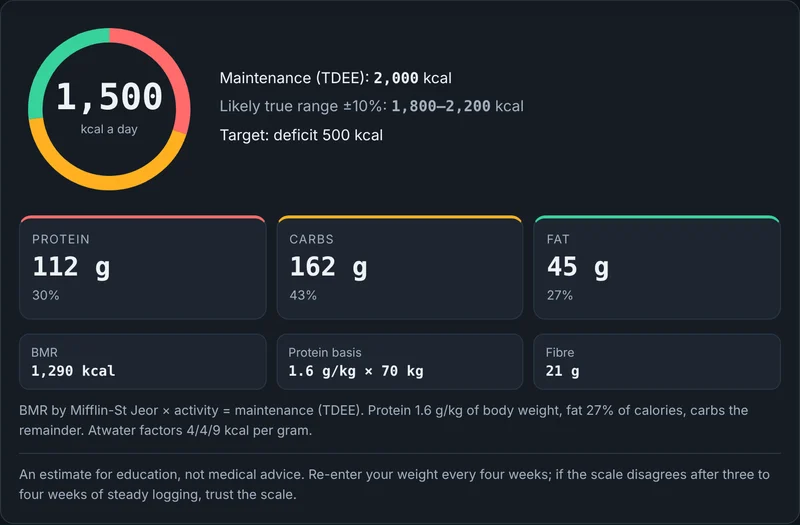
That is 43% of calories, just under the AMDR floor, which is normal in a deficit. Healthy low-carb and low-fat diets produced similar weight loss over 12 months in 609 adults (Gardner et al., 2018, JAMA).
Deficit and floor. The tool subtracts 500 kcal from TDEE and never goes below 1,200 kcal for women or 1,500 kcal for men, the low ends of the reduced-calorie diets in the 2013 AHA/ACC/TOS obesity guideline (Jensen et al., Circulation).
Macros for women
A macro calculator for women uses the female Mifflin-St Jeor constant, which gives a BMR 166 kcal lower than a man of the same height, weight and age (Mifflin et al., 1990). Calories and carbs come out lower, protein per kilogram stays the same, and weight loss keeps a firm 1,200 kcal minimum.
Pregnancy and breastfeeding switch the deficit off.
Are macro calculators accurate?
A good macro calculator’s energy estimate carries about a ±10% prediction error. In a systematic review against indirect calorimetry, Mifflin-St Jeor landed within 10% of measured resting energy more often than any other formula, though some adults fell outside that band (Frankenfield et al., 2005, J Am Diet Assoc). That is why results print as a range.
If the scale disagrees with the target after three to four weeks of steady logging, trust the scale.
Are macro calculators safe for beginners, and who should not follow one?
Macro calculators are safe for most healthy beginners, but six groups need changed or withheld numbers. This calculator asks six screening questions and alters its output for chronic kidney disease (CKD), pregnancy, type 1 diabetes or insulin use, GLP-1 receptor agonist medication, age under 18, and an eating disorder history.
| Condition | What the tool does | Source |
|---|---|---|
| CKD or eGFR below 60 | Caps protein at 0.8 g/kg/day, the adult RDA; nephrologist referral | KDIGO 2024 |
| Pregnancy or breastfeeding | No deficit shown | ACOG; IOM 2009 |
| Type 1 diabetes, insulin or sulfonylurea | Warns carb changes need a dose review | ADA Standards of Care |
| GLP-1 receptor agonist | Protein floor first, to protect muscle | ACLM/ASN/OMA/TOS advisory, 2025 |
| Under 18 | No deficit; pediatric review | AAP, 2016 (Pediatrics) |
| Eating disorder history | No numbers; helpline shown | Levinson et al., 2017 (Eat Behav) |
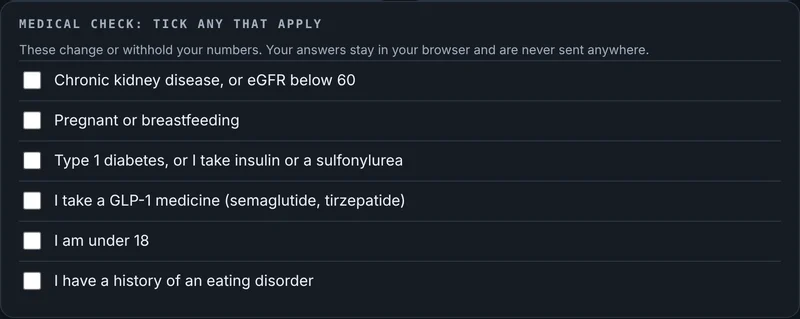
Why the screen exists. A gym-goer’s protein target can strain damaged kidneys, and a carb cut can cause hypoglycemia on insulin.
How do I adjust my macros as I lose weight?
Re-enter your current weight every four weeks to recalculate your macros. A lighter body burns less, and metabolic adaptation lowers energy expenditure further than weight loss alone predicts (Rosenbaum & Leibel, 2010, Int J Obes). If weight stalls for three weeks with steady logging, lower carbs or fat by a small step and keep protein where it is.
Macro calculator FAQ
Is this macro calculator free?
Yes. Free online, no sign-up; results show grams and percentage together.
What are the benefits of using a macro calculator?
Daily gram targets replace guesswork, and the medical screen flags reasons to change them.
Are macros and micronutrients the same?
No. Macros supply calories; micronutrients such as iron and vitamin D supply none.
Can I add this calculator to my website?
Yes. Paste the code below into any page. It loads the full tool, medical screen included, keeps the RaphaAtlas credit and fits your column, so clinics and gyms can offer it to patients.
html
<iframe src="https://raphaatlas.com/embed/macro-calculator/" width="100%" height="1850" title="RaphaAtlas macro calculator" loading="lazy" style="border:0"></iframe>Check your body type next.