
By Dr. Muhammad Awais Rabbani, MBBS · Medically reviewed by Dr. Ahmed Humayon, MBBS · Updated 3 November 2026 · Editorial policy
Normal triglycerides levels for adults are below 150 mg/dL (1.7 mmol/L) after fasting. Under the NCEP ATP III guideline, 150–199 mg/dL is borderline high, 200–499 mg/dL is high, and 500 mg/dL (5.6 mmol/L) or more is very high (NCEP ATP III, 2002).
Check your triglyceride number
Cut-offs from NCEP ATP III (2002), Endocrine Society (2012), NHLBI (2011), EAS/EFLM (2016) and 2018 AHA/ACC. Sources checked 2 November 2026. Tool logic reviewed by Dr. Ahmed Humayon, MBBS. This tool does not diagnose.
Type the triglyceride value from your lab report, pick mg/dL or mmol/L, and say whether you fasted. The checker places the number in its guideline band, converts it to the other unit, names the guideline behind the band, and gives the next step a physician would usually take, including a warning when the calculated LDL on the same report stops being reliable.
Look for the line marked TG, TRIG or triglycerides on your lipid panel.
Children and teens are judged on lower cut-offs, so set the age group before you check. The checker does not diagnose anything, and one result says little about heart disease risk on its own. Your healthcare provider reads it next to LDL cholesterol, HDL cholesterol, blood pressure, smoking status and your history, and usually asks for a repeat before acting on a single borderline value.
What is a normal triglyceride level?
A normal triglyceride level for adults is below 150 mg/dL (1.7 mmol/L) on a fasting sample, according to the National Cholesterol Education Program (NCEP ATP III, 2002). The same cut-off applies to men and women. NCEP ATP III does not publish separate bands by sex or by adult age, so the checker applies one adult scale from age 20.
| Fasting result (mg/dL) | mmol/L | NCEP ATP III (2002) | Endocrine Society (2012) |
|---|---|---|---|
| Under 150 | Under 1.7 | Normal | Normal |
| 150–199 | 1.7 to under 2.3 | Borderline high | Mild |
| 200–499 | 2.3 to under 5.6 | High | Moderate |
| 500–999 | 5.6 to under 11.3 | Very high | Moderate |
| 1,000–1,999 | 11.3 to under 22.6 | Very high | Severe |
| 2,000 or more | 22.6 or more | Very high | Very severe |
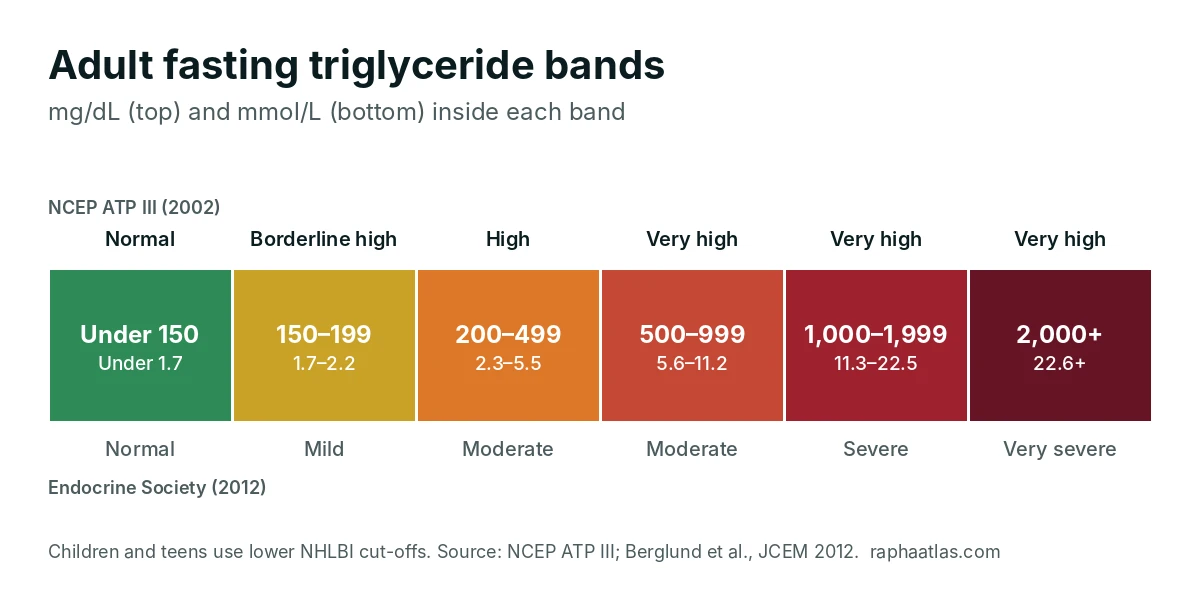
Most US labs report in milligrams per deciliter (mg/dL); labs in the UK, Europe, Canada and Australia use mmol/L. To convert, multiply mg/dL by 0.01129 to get mmol/L, or multiply mmol/L by 88.57 to get mg/dL. A result of 2.0 mmol/L equals about 177 mg/dL, and the adult cut-off of 150 mg/dL reads as 1.7 mmol/L on a UK or Australian report.
Why two schemes? NCEP ATP III was written to predict heart disease, so it stops at “very high”. The Endocrine Society guideline (Berglund et al., 2012) splits the upper range further because the risk of pancreatitis climbs steeply above 1,000 mg/dL, and that changes how fast treatment has to start.
The checker shows both labels.
What are triglycerides?
Triglycerides are a type of fat in your blood. Each molecule is three fatty acids joined to a glycerol backbone. Your body burns them for energy between meals and stores the extra calories you eat as triglycerides in fat cells, then releases them again when it needs fuel.
They reach the blood by three routes:
- Food. The gut packs dietary fat into large particles called chylomicrons, which enter the blood a few hours after a meal.
- The liver. It turns surplus sugar, refined carbohydrate and alcohol into triglycerides and ships them out in VLDL particles.
- Fat cells. Between meals, stored fat is broken down and released into the blood as fatty acids.
An enzyme called lipoprotein lipase, sitting on the inner lining of the smallest capillaries, strips triglycerides out of these particles so muscle and fat tissue can take up the fuel. When the enzyme works poorly, because of a rare inherited defect or, far more often, poorly controlled diabetes or heavy drinking, triglycerides pile up in the blood.
Are triglycerides good or bad? They are lipids you need. Trouble starts with the amount.
Triglyceride-rich particles also carry cholesterol, and raised levels go along with higher rates of coronary artery disease (Miller et al., AHA scientific statement, 2011).
Normal triglyceride levels for children and teens
Children and teens have lower triglyceride cut-offs than adults. Under the 2011 NHLBI Expert Panel guideline for children, a fasting level below 75 mg/dL is acceptable from birth to 9 years, and below 90 mg/dL is acceptable from 10 to 19 years (NHLBI, 2011). Adult cut-offs start at age 20.
| Age | Acceptable | Borderline high | High |
|---|---|---|---|
| 0–9 years | Under 75 mg/dL (0.85 mmol/L) | 75–99 mg/dL | 100 mg/dL or more (1.13 mmol/L) |
| 10–19 years | Under 90 mg/dL (1.02 mmol/L) | 90–129 mg/dL | 130 mg/dL or more (1.47 mmol/L) |
| Adults 20+ | Under 150 mg/dL (1.7 mmol/L) | 150–199 mg/dL | 200 mg/dL or more (2.3 mmol/L) |
The same panel advises repeating an abnormal result on a second fasting sample and averaging the two before acting.
Its borderline and high cut-offs sit at roughly the 75th and 95th percentiles for US children, so a teen’s 135 mg/dL is unusual for that age even though it would pass as normal in an adult.
Do you need to fast for a triglyceride test?
Usually not for routine screening. The European consensus (Nordestgaard et al., EAS/EFLM, 2016) and the 2018 AHA/ACC cholesterol guideline both accept a non-fasting sample. EAS/EFLM flags a non-fasting triglyceride of 175 mg/dL (2.0 mmol/L) or more as abnormal, and a fasting repeat is the usual next step. If your report does not say which sample you gave, ask the lab.
A meal raises the number for a few hours because chylomicrons from the food are still in the blood. In the population data behind the EAS/EFLM consensus, the largest average rise 1 to 6 hours after a usual meal was about 26 mg/dL (0.3 mmol/L), which is why screening no longer demands an empty stomach.
Fasting still matters in three cases: a borderline or high non-fasting result, a value of 400 mg/dL or more, where the 2018 AHA/ACC guideline asks for a fasting repeat (Grundy et al., 2018), and any test meant to track treatment. When fasting is requested, NCEP ATP III uses 9 to 12 hours with water only.
Very high levels can turn the serum milky. Labs call this a lipemic sample and may dilute it or ask for a repeat.
What the test costs and how insurance codes it
On a US bill or explanation of benefits, a full lipid panel appears as CPT 80061 and a triglyceride-only test as CPT 84478. The diagnosis code on the order decides which rules apply. A routine screen usually carries ICD-10 Z13.6 (screening for cardiovascular disorders). A repeat ordered because of a high result carries a diagnosis such as E78.1 (pure hyperglyceridemia) and is handled as a diagnostic test.
Medicare Part B covers cardiovascular screening blood tests, which include a triglyceride test, once every 5 years for people without signs of heart disease, and you pay nothing if the provider accepts assignment (Medicare.gov; CMS). A second panel inside that window has to stand on a diagnosis.
Dr. Rabbani also runs Growth Partners Global, a US medical billing company; the codes and rules here come from the published CPT, ICD-10-CM and CMS sources listed below.
What counts as high triglycerides?
High triglycerides means a fasting level of 200 mg/dL (2.3 mmol/L) or more under NCEP ATP III, with 150–199 mg/dL counted as borderline high. The Endocrine Society (Berglund et al., 2012) calls any value from 150 mg/dL upward hypertriglyceridemia and grades it mild, moderate, severe or very severe.
Below 150 mg/dL is normal on both scales.
High triglyceride levels in the 150–499 mg/dL range almost never cause symptoms. They matter over years. High blood triglycerides cluster with reduced HDL, a large waist and raised blood sugar in metabolic syndrome, and they are a marker of heart attack risk alongside LDL cholesterol (Miller et al., 2011). The 2018 AHA/ACC guideline treats a level that stays at 175 mg/dL or more as a risk factor that can tip the decision toward a statin. A single blood test in this range is a prompt to look for causes, covered in the next section.
When it is urgent. At 500 mg/dL (5.6 mmol/L) and above, the bigger short-term danger moves from the heart to the pancreas. Severe hypertriglyceridemia, especially above 1,000 mg/dL (11.3 mmol/L), can trigger acute pancreatitis (Berglund et al., 2012). Sudden upper abdominal pain with a result in this range needs same-day medical care, along with an urgent repeat and a pancreatic enzyme check.
At very high levels, crops of small yellow-red bumps called eruptive xanthomas can appear on the buttocks, elbows and knees. They are the one sign you can see.
What does your triglyceride result mean on a blood test?
A triglyceride result on a blood test shows how much fat was circulating when the sample was taken. One raised number is a reason to find the cause before treating it. A physician confirms the value on a fasting repeat, then checks for the conditions that push triglycerides up.
The usual work-up, based on the Endocrine Society guideline (Berglund et al., 2012):
- A fasting repeat, if the first sample was non-fasting or sits near a cut-off.
- HbA1c or fasting glucose, since uncontrolled type 2 diabetes is one of the most common secondary causes.
- TSH, because an underactive thyroid raises both triglycerides and LDL.
- eGFR from a creatinine test and a urine protein check, to look for kidney disease.
- Liver tests and an honest account of alcohol use, since heavy drinking and fatty liver disease both raise levels.
- A medicine review: oral estrogen, steroids, some diuretics and beta-blockers, isotretinoin and some HIV drugs can all lift triglycerides.
- Family history of very high triglycerides, or of heart disease before 55 in a male relative or before 65 in a female relative.
Most raised results come from a fixable secondary cause, so treating the diabetes, the thyroid or the drinking often brings the number down on its own. When levels stay severe after that, the Endocrine Society makes a fibrate the first-line drug, because the aim at that point is preventing pancreatitis.
Triglycerides vs cholesterol
Triglycerides and cholesterol are both lipids measured on the same lipid panel, and they do different jobs. Triglycerides store and carry energy. Cholesterol builds cell membranes and hormones. Both travel in the blood inside lipoproteins, and raised levels of either add to cardiovascular disease risk, with LDL cholesterol the main treatment target in US guidelines (Grundy et al., 2018 AHA/ACC).
| Triglycerides | Cholesterol (LDL) | |
|---|---|---|
| What it is | Stored fat used for fuel | Structural lipid for cells and hormones |
| What raises it most | Extra calories, sugar, alcohol, diabetes, some medicines | Saturated fat, inherited conditions, hypothyroidism |
| What the number predicts | Pancreatitis risk when very high; a marker of heart risk | The main target for preventing heart attack |
Total cholesterol counts LDL, HDL and the cholesterol carried inside triglyceride-rich particles. Subtract HDL and you get non-HDL cholesterol, which covers every particle able to enter an artery wall. NCEP ATP III made non-HDL a second treatment target once triglycerides reach 200 mg/dL. Low HDL often travels with high triglycerides; see how to raise HDL cholesterol.
Check your LDL line when triglycerides are high. Many labs calculate LDL with the Friedewald equation, which is not valid once triglycerides reach 400 mg/dL (4.5 mmol/L) (Friedewald et al., 1972). Labs may switch to the Martin-Hopkins method (Martin et al., 2013), which holds up better at high triglycerides, or measure LDL directly. If your report shows triglycerides of 400 mg/dL or more beside a calculated LDL, ask which method was used.
An apolipoprotein B (ApoB) test counts atherogenic particles directly, so it reads true when triglycerides are high. The 2018 AHA/ACC guideline counts an ApoB of 130 mg/dL or more as a risk-enhancing factor and names triglycerides of 200 mg/dL or higher as the main reason to order the test.
Read what an ApoB test adds and where your LDL should sit.
What raises triglycerides and what brings them down?
Triglycerides rise with extra calories, added sugar, refined carbohydrates and alcohol, and with conditions such as type 2 diabetes, hypothyroidism and kidney disease. They fall with weight loss, less sugar and alcohol, regular physical activity and, when levels are very high or lifestyle changes are not enough, prescription medicine chosen by your doctor after the work-up above.
Common raisers:
- Weight gain and eating more.
- Added sugar and refined carbohydrates
- Alcohol, even in modest amounts for some people
- Uncontrolled diabetes, an underactive thyroid or kidney disease
- Late pregnancy and some medicines
Main levers:
- Losing excess weight
- Cutting added sugar and refined carbohydrates
- Cutting back on alcohol, and avoiding it entirely at 500 mg/dL or more
- Exercise most days
- At 500 mg/dL or more, omega-3 fatty acids and, if needed to prevent pancreatitis, a fibrate (Grundy et al., 2018)
Frequently asked questions
What is a normal triglyceride level?
For adults, below 150 mg/dL (1.7 mmol/L) on a fasting sample, under NCEP ATP III.
What is a good triglyceride level?
The American Heart Association’s 2011 statement calls a fasting level under 100 mg/dL optimal (Miller et al., 2011). NCEP ATP III sets the upper limit of normal at 150 mg/dL, so a result between 100 and 149 is normal but not optimal. Children use lower cut-offs: below 75 mg/dL up to age 9 and below 90 mg/dL from 10 to 19.
Is it bad when your triglycerides are high?
Moderately high triglycerides add to heart risk over years, usually without symptoms. Above 500 mg/dL they also raise the risk of acute pancreatitis.
Do you need to fast for a triglyceride test?
Usually not for screening. A non-fasting result of 175 mg/dL (2.0 mmol/L) or more is normally repeated after 9 to 12 hours without food to confirm it, and a non-fasting value of 400 mg/dL or more should always be repeated fasting before anyone reads the LDL on the same report.
What is the difference between triglycerides and cholesterol?
Triglycerides are stored fat used for energy. Cholesterol is a structural lipid for cells and hormones.
Can triglycerides be too low?
Rarely in a way that matters. Very low values can come with an overactive thyroid, poor fat absorption or a very low-fat diet. Mention it to your doctor if you also have weight loss or diarrhea, because those point to a cause worth checking rather than to the number itself.
Sources
- National Cholesterol Education Program Expert Panel. Third Report on Detection, Evaluation, and Treatment of High Blood Cholesterol in Adults (ATP III). Circulation. 2002;106(25):3143–3421.
- Berglund L, Brunzell JD, Goldberg AC, et al. Evaluation and treatment of hypertriglyceridemia: an Endocrine Society clinical practice guideline. J Clin Endocrinol Metab. 2012;97(9):2969–2989.
- Expert Panel on Integrated Guidelines for Cardiovascular Health and Risk Reduction in Children and Adolescents (NHLBI). Pediatrics. 2011;128(Suppl 5):S213–S256.
- Nordestgaard BG, Langsted A, Mora S, et al. Fasting is not routinely required for determination of a lipid profile. EAS/EFLM joint consensus statement. Eur Heart J. 2016;37(25):1944–1958.
- Grundy SM, Stone NJ, Bailey AL, et al. 2018 AHA/ACC/multisociety Guideline on the Management of Blood Cholesterol. Circulation. 2019;139(25):e1082–e1143.
- Miller M, Stone NJ, Ballantyne C, et al. Triglycerides and cardiovascular disease: a scientific statement from the American Heart Association. Circulation. 2011;123(20):2292–2333.
- Friedewald WT, Levy RI, Fredrickson DS. Estimation of the concentration of low-density lipoprotein cholesterol in plasma, without use of the preparative ultracentrifuge. Clin Chem. 1972;18(6):499–502.
- Martin SS, Blaha MJ, Elshazly MB, et al. Comparison of a novel method vs the Friedewald equation for estimating LDL cholesterol. JAMA. 2013;310(19):2061–2068.
- Medicare.gov. Cardiovascular disease screenings. (accessed 2 November 2026)
- CMS. Medicare preventive services: cardiovascular disease screening tests. (accessed 2 November 2026)
- CMS. ICD-10-CM code set (Z13.6, E78.1). American Medical Association. CPT code set (80061, 84478).