
By Dr. Muhammad Awais Rabbani, MBBS, a physician who writes about exercise physiology and energy expenditure · Medically reviewed by Dr. Ahmed Humayon, MBBS · Updated 29 October 2026 · Editorial policy
A 154-lb (70 kg) person walking at 3.5 mph on a 10% incline for 30 minutes burns about 313 calories, or about 276 net once resting calories are subtracted, using the American College of Sports Medicine treadmill equation (ACSM Guidelines, 12th ed., 2025).
This treadmill calculator updates as you type. For cycling or lifting, use the calories burned calculator.
How many calories does 30 minutes on a treadmill burn?
Thirty minutes on a treadmill burns about 121 calories for a 154-lb (70 kg) person walking 3 miles per hour on flat ground, 273 at the same treadmill speed on a 10% incline, and 375 running 6 mph. All are gross figures from the ACSM walking and running equations (ACSM Guidelines, 12th ed.), so heavier walkers burn proportionally more.
| mph \ incline | 0% | 3% | 5% | 8% | 10% | 12% | 15% |
|---|---|---|---|---|---|---|---|
| 2.0 | 93 | 123 | 144 | 174 | 194 | 215 | 245 |
| 2.5 | 107 | 145 | 171 | 209 | 234 | 259 | 297 |
| 3.0 | 121 | 167 | 197 | 243 | 273 | 304 | 349 |
| 3.5 | 135 | 189 | 224 | 277 | 313 | 348 | 401 |
| 4.0* | 149 | 210 | 251 | 312 | 352 | 393 | 454 |

| mph \ incline | 0% | 1% | 3% | 5% |
|---|---|---|---|---|
| 5 | 318 | 331 | 356 | 382 |
| 6 | 375 | 390 | 420 | 451 |
| 7 | 431 | 449 | 484 | 520 |
| 8 | 487 | 508 | 548 | 589 |
| 9 | 544 | 567 | 612 | 658 |
At 3.5 mph and 10%, the same duration costs 246 kcal at 55 kg, 380 at 85 kg and 447 at 100 kg.
How do treadmills calculate calories? (the ACSM formula)
Treadmill calorie estimates convert belt speed and grade into oxygen uptake (VO₂, in mL/kg/min), then multiply by body weight and by about 5 kcal per litre of oxygen consumed (ACSM Guidelines, 12th ed.). The American College of Sports Medicine publishes one walking equation and one running equation for this, and both take speed and grade directly.
ACSM walking equation:  VO₂ = 3.5 + 0.1·S + 1.8·S·G
ACSM running equation:  VO₂ = 3.5 + 0.2·S + 0.9·S·G
S = speed in metres per minute (1 mph = 26.8 m/min)
G = fractional grade (10% = 0.10)
Gross kcal/min = VO₂ × kg ÷ 1,000 × 5
Net kcal/min   = (VO₂ − 3.5) × kg ÷ 1,000 × 5
At 3.5 mph (93.9 m/min) and 0.10 grade, VO₂ is 29.8 mL/kg/min, or 313 kcal in 30 minutes at 70 kg. Flat running costs about 1 net kcal per kilogram per kilometre, roughly 113 calories per mile at 70 kg, and flat walking half that. The tool switches equations at the walk-to-run transition; you can override it.
I calculate calories burned with the ACSM equations rather than a MET table because they take speed and grade directly. A treadmill console estimate uses the same settings plus your entered weight, so a console with no weight field is guessing at you.
Against pooled indirect calorimetry data, the walking equation read low in 97% of level-walking cases (Ludlow & Weyand, 2016) and the running equation read high in 29 of 33 runners (Ruiz & Sherman, 1999), so no single ± range fits and results show as estimates.
Other physical activity uses Compendium-based estimates for 100+ other activities built on MET values from the Compendium of Physical Activities (2024).
Gross vs net calories: what does the kcal on a treadmill mean?
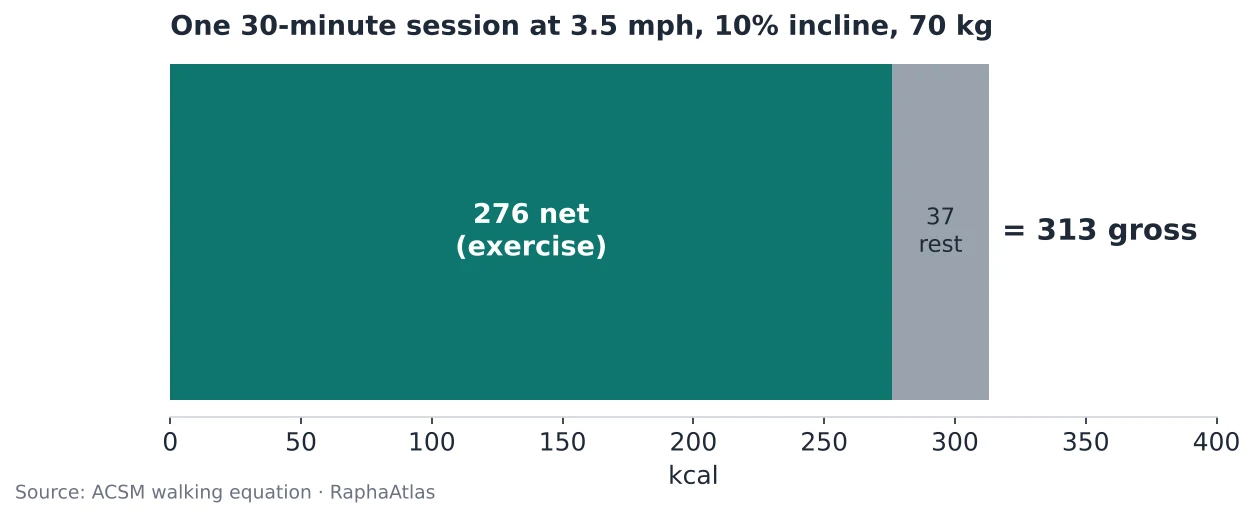
Kcal on a treadmill means kilocalories, the same unit on food labels. Gross calories count everything burned during the session, including your resting metabolism. Net calories subtract that resting share, about 1 kcal per kg per hour (1 MET, or 3.5 mL/kg/min), to show the extra calories the treadmill workout itself added (ACSM Guidelines, 12th ed.).
| Figure | What it counts | kcal |
|---|---|---|
| Gross calories | Everything burned during the 30 minutes | 313 |
| Net calories | Gross minus the 37 kcal you would burn at rest | 276 |
Use net calories when you plan a calorie deficit to lose weight.
How much does incline increase calorie burn?
Each 1% of incline adds about 15 calories per 30 minutes for a 154-lb person walking 3 mph. Raising the treadmill grade from flat to 15% almost triples treadmill calorie burn, from 121 to 349 kcal, by the ACSM walking equation (ACSM Guidelines, 12th ed.).
| Incline | 0% | 5% | 10% | 15% |
|---|---|---|---|---|
| kcal | 121 | 197 | 273 | 349 |

Treadmill running removes air resistance, so flat belt running costs slightly less than outdoor running at the same pace. Jones and Doust (1996) found that a 1% grade best matched the energy cost of running outside, which is why Table 2 carries a 1% column for anyone who wants road-equivalent numbers.
The incline input stops at 0%. ACSM’s equations are not validated for downhill or negative grade.
How many calories does the 12-3-30 workout burn?
The 12-3-30 workout (12% incline, 3 mph, 30 minutes) burns about 304 calories for a 154-lb (70 kg) person, or 267 net calories, by the ACSM walking equation (ACSM Guidelines, 12th ed.). Tap Load 12-3-30 in the calculator to fill in those settings.
| Weight | 55 kg (121 lb) | 70 kg (154 lb) | 85 kg (187 lb) | 100 kg (220 lb) |
|---|---|---|---|---|
| kcal | 239 | 304 | 369 | 434 |
Net runs about 12% below gross at these settings, whatever you weigh.
Does holding the handrails reduce calories burned?
It depends on how you hold them. In 13 healthy adults walking at a 10% incline, holding the handrails while staying upright lowered energy use by about 12%, a drop that wasn’t statistically significant, while holding on and leaning back cut it by about 32%, to the level of walking unsupported at 5% (Hofmann et al., 2014).
Every number here assumes hands-free walking, so read a rail-supported session as an overestimate.
Holding the rails? The calculator applies no correction, since one small study can’t set a factor for every grip. Ticking the box adds a reminder.
How long on a treadmill to burn 500 calories?
A 154-lb person needs about 48 minutes at 3.5 mph and 10% incline to burn 500 calories, or about 124 minutes walking 3 mph on flat ground. Switch the calculator to Calories → time and enter your own target calories (ACSM Guidelines, 12th ed.).
| Setting | 100 kcal | 300 kcal | 500 kcal |
|---|---|---|---|
| 3.0 mph, flat | 25 (36) | 74 (107) | 124 (178) |
| 3.5 mph, 10% | 10 (11) | 29 (33) | 48 (54) |
| 3.0 mph, 12% (12-3-30 settings) | 10 (11) | 30 (34) | 49 (56) |
| 6.0 mph run, flat | 8 (9) | 24 (27) | 40 (44) |
For weight loss and fat loss, plan with the bracketed net minutes against how many calories you need a day. Incline is the biggest lever at walking pace, because a 12% grade at 3 mph reaches 500 kcal in 49 minutes against 124 on flat ground, so treadmill sessions burn more calories without a run.
Treadmill calorie FAQ
Does it work on my NordicTrack, Peloton, Precor, Life Fitness or Planet Fitness treadmill?
Yes. Any treadmill that shows speed and incline works, with your weight and minutes.
What about a curved treadmill?
Expect more. On a curved, non-motorized treadmill you drive the belt, and trained runners worked about 16% harder relative to peak oxygen uptake than on a motorized belt at equal speed (Edwards et al., 2017).
Can I add a weighted vest?
Extra load raises the oxygen cost, and this tool doesn’t model it, so expect a vest session to burn more than the estimate.
Can I use my step count instead?
Steps carry no speed or incline data, so this tool can’t use them. For a walk logged only by time, the calories burned calculator works from minutes.
Sources and method
Walking equation up to 3.7 mph, running equation from 5 mph, your chosen gait in between. Estimates for healthy adults, not clinical exercise prescription. Written by a physician and medically reviewed. Last reviewed 29 October 2026.
- American College of Sports Medicine; Ozemek C, ed. ACSM’s Guidelines for Exercise Testing and Prescription. 12th ed. Wolters Kluwer; 2025.
- Jones AM, Doust JH. A 1% treadmill grade most accurately reflects the energetic cost of outdoor running. J Sports Sci. 1996;14(4):321–327.
- Ludlow LW, Weyand PG. Energy expenditure during level human walking: seeking a simple and accurate predictive solution. J Appl Physiol. 2016;120(5):481–494.
- Ruiz A, Sherman NW. An evaluation of the accuracy of the American College of Sports Medicine metabolic equation for estimating the oxygen cost of running. J Strength Cond Res. 1999;13(3):219–223.
- Hofmann C, Dougherty C, Abkarian H, Fox M, Juris P. The reduction of metabolic cost while using handrail support during inclined treadmill walking is dependent on the handrail-use instruction. Int J Exerc Sci. 2014;7(4):339–345.
- Edwards RB, Tofari PJ, Cormack SJ, Whyte DG. Non-motorized treadmill running is associated with higher cardiometabolic demands compared with overground and motorized treadmill running. Front Physiol. 2017;8:914.
- Herrmann SD, Willis EA, Ainsworth BE, et al. 2024 Adult Compendium of Physical Activities: a third update of the energy costs of human activities. J Sport Health Sci. 2024;13(1):6–12.